

Quick Chat: Kevin Chen
Kevin Chen is the co-founder and CEO of Hyasynth Bio. He completed his Honors Bachelor of Science in Biochemistry at Queen's University and went on to start up Hyasynth Bio. Hyasynth Bio is a synthetic biology company that specializes in creating strains of yeast that produce cannabinoids. Cannabinoids are naturally occurring compounds found in the cannabis plant, two of the most popular being THC and CBD. Cannabinoids have applications in nutritional, pharmaceutical, and recreational-use products. Since Hyasynth specializes in engineered yeast, their platform is adaptable, efficient, and scalable. The yeast is grown in fermenters and fed sugar and water over the course of a few days, after which the end product is extracted and purified. The cannabinoids can be included in a variety of products including pills, oils, and topical formats. The goal of Hyasynth is to customize combinations of cannabinoids and find rare cannabinoids that can be beneficial for a variety of diseases.
EMMA LINDSAY - AUGUST 23rd, 2022
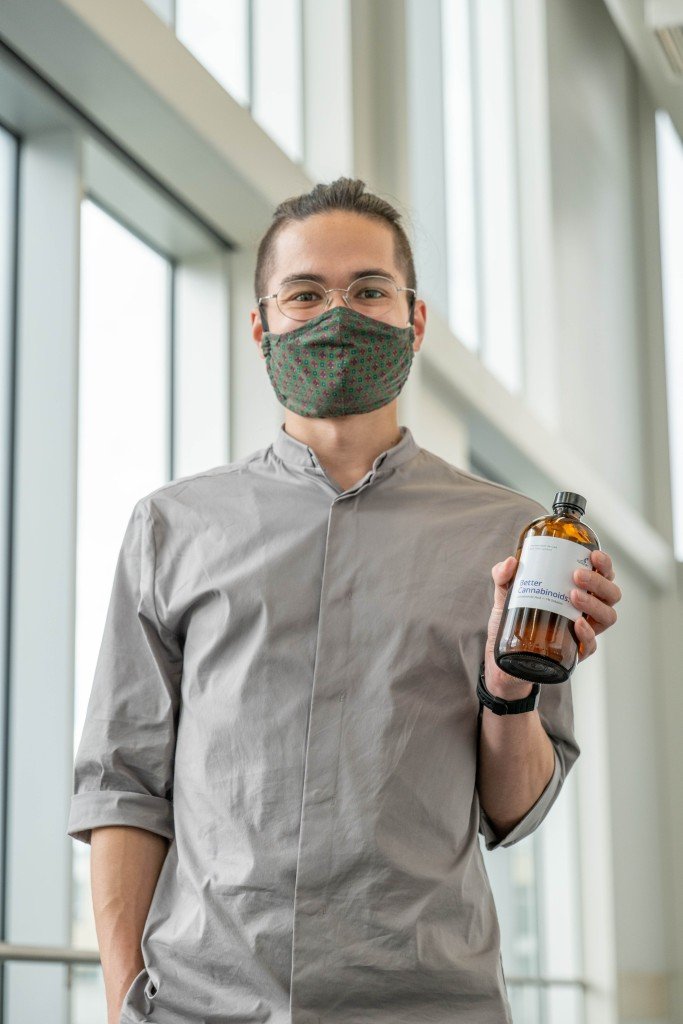
Kevin Chen is the co-founder and CEO of Hyasynth Bio. He completed his Honors Bachelor of Science in Biochemistry at Queen's University and went on to start up Hyasynth Bio. Hyasynth Bio is a synthetic biology company that specializes in creating strains of yeast that produce cannabinoids. Cannabinoids are naturally occurring compounds found in the cannabis plant, two of the most popular being THC and CBD. Cannabinoids have applications in nutritional, pharmaceutical, and recreational-use products. Since Hyasynth specializes in engineered yeast, their platform is adaptable, efficient, and scalable. The yeast is grown in fermenters and fed sugar and water over the course of a few days, after which the end product is extracted and purified. The cannabinoids can be included in a variety of products including pills, oils, and topical formats. The goal of Hyasynth is to customize combinations of cannabinoids and find rare cannabinoids that can be beneficial for a variety of diseases.
What is Hyasynth?
We are focused on genetic engineering of yeast for the production of natural compounds, but specifically cannabinoids. So instead of growing cannabis to get THC and CBD, we grow yeast. We are able to isolate those interesting ingredients, and do that in a much more efficient and sustainable way than growing cannabis. Right now the cannabis or cannabinoid industry is developing in a very bizarre way where on one hand, the science behind it, the endocannabinoid system, is super relevant to all kinds of human health, for example in cardiovascular and neurological aspects. There's so many things that cannabinoids tie into that is going to be a huge topic to research because of what it can do for human health. But at the same time, this system is tied to the cannabis plant and everything that it’s known for, all this narcotics stuff and there's a lot of noise, so the whole space gets looked at in a bit of a funny way. It's tied to this current supply chain and to this whole idea that you have to grow cannabis. For Hyasynth, we're saying we don't have to make cannabinoids using plants, we can do it using synthetic biology, and biosynthesis, and have a regulated, clean, and scalable supply for these things. We started out from scratch where there wasn't a whole lot of research done on these enzymes or the chemistry or anything about them. So it was a lot of basic research that we had to do in those early days to figure out how we actually biosynthesize cannabinoids inside a yeast cell. And on that journey, we came across some super interesting stuff, we developed some really interesting technology platforms. But in the end what we have are strains of yeast that produce CBD at levels that are competitive to the cannabis plant and that's what we’re on our way to commercializing now.
What does a day to day look like at Hyasynth?
You show up to work, you know who and what you’re working for. We all understand the purpose of the company and we’re all similarly minded where we all care about the future, the technology, each other, and how we progress ourselves in our career paths. There's a lot of mutual respect and a great team environment to work in where people are supportive of each other. There’s plenty of ways to build your expertise, skill set, try new experiments, and learn about the leading ways you can engineer yeast. My job day to day is to send emails and take phone calls. It's not very exciting. But I do love to meet new investors that are looking at synthetic biology that don't really understand it and want to learn more about it because it's part of an ongoing revolution, and that's exciting for me. I also love to hear about all the technology we develop at Hyasynth when we come up with new ideas or when we find some fun way to engineer yeast. That’s all pretty amazing to hear when we get breakthroughs like that. So I hear about those things and tell investors about how cool we are. That's what I do.

Is there a benefit to using yeast over other techniques?
In the end, every host organism has its own properties so yeast is one of the generally accepted ones where people know how to grow it and work with it. The genomic tools are pretty widely available and well understood so it's not like you're troubleshooting and falling more into discovery land. It grows quickly and easily, and it's not super sensitive to certain reactive conditions or contamination. So it makes a pretty good overall picture for a manufacturing system. Every organism will perform differently. There's research being done into new host organisms for other things as well, which is all very cool stuff. But, for at least the cannabinoid pathway, yeast is clearly the most efficient organism to host this pathway, and like I said, more so than cannabis itself.
How did you get involved with synbio?
I got into synbio through the iGEM competition back in 2011/2012 and at the time I was studying biochemistry at Queen's University. I had a super great experience. It opened my eyes a bit to the world of synbio and genetic engineering, which I was always passionate about ever since [I learned about] the idea of DNA and genomics as a blueprint for living things. The concept was always interesting to me. After doing IGEM, I got to know a couple people who were starting a synthetic biology company in Canada, which at the time was called Synbiota. It was through that experience with that start up company, and with these couple Canadian entrepreneurs that were bold enough to start a synthetic biology company here, that got me interested in the idea of starting a company as opposed to joining the industry or joining academia. I thought that was super awesome because I was coming from this IGEM experience of we’re a team, we’re coming up with our own ideas, we're solving these problems, we're thinking about how this actually exists in reality, and I loved all of those things. It wasn't like I had one thing where I loved technology or science, or I loved the effect on society, or the economics of it. In the end, all of it coming together was what I loved the most, and working as a team was also a big part of what I liked about that. After being connected to the start up I also started my masters degree at McGill University and during that degree was where I felt like I was taking a step back cause the environment was such a contrast to what I was already getting excited about. Once the opportunity came around to start Hyasynth, I knew this was what I really wanted to do, and starting a synthetic biology company is the best thing for me. At the time we were among the first companies in Canada to really focus on synthetic biology. That was in the year 2014, where we kicked things off and that's when we got founded. That was also when I dropped out of my masters degree at McGill and did this full time.

Why do you think synthetic biology is such an important field?
Some people define synthetic biology as some kind of sub-sector of biotechnology as a whole but really, think of synthetic biology as anything genetic engineering related or something that is geared by synthetic DNA. Even every mRNA vaccine we've seen to date or DNA-based vaccines that are helping us with COVID stuff, that’s all synthetic biology. How can you look at that and argue that there’s no impact of synthetic biology? Because it clearly defines the world. The investment towards it is super clear from the human health standpoint. Where it also gets interesting is when you look at the agricultural impact as well. Which is a bit more where Hyasynth applies. We're going to replace an agricultural process with a fermentation process and have a massive benefit to the carbon impact and human health by doing so. There's quite a few companies that do lean in the direction of what other parts of manufacturing or society can be improved by synthetic biology. But anywhere where there's a microorganism or a living thing that can be worked with at the DNA level, there's an opportunity for those things to be improved or better understood through the study of synthetic biology. And even beyond that, you can consider very cool things like the use of DNA and data storage as another branch of synbio that is on its way. There's other fun things with aptamers or RNA ribozymes that fall into the category of synthetic biology because they’re still based on synthetic nucleotides. Those are fields where they’ll change things about diagnostics or changing the analytical chemistry that are on their way too. Synbio is already the root of a lot of what we do. It might boil down to a way of thinking around it. This is a point I do want to stress when it comes to a lot of synbio. When you think about the tools that we have to do research, to do science, to solve a problem, that's where the tools are starting to change a bit. Where you might’ve originally had the idea of chemically synthesizing cannabinoids, that would be the easy way to do it, that's the way we can do it scalably, there's no such thing as a yeast that can produce cannabinoids, that's impossible. But these days, it's actually quite possible and quite easy to realize. It becomes clear how to engineer yeast to do these things. Or even the mRNA vaccine where it was super relevant for COVID stuff, but the original story with a lot of the mRNA vaccines was more around oncology. So the platform was transferable. That’s the interesting thing that you can change about the way research is thought about and how these tools are looked at. Once you can synthesize DNA and use that for a problem, that can be reapplied in a lot of different ways and you start to see a lot of platform based approaches on things. Start to think of DNA or RNA as a tool kit or platform that can be engineered or tailored to whatever need you have. I think that's the big difference between biotechnology of yesterday and synthetic biology of today.
What do you think is the biggest obstacle for synthetic biology research?
In some ways I feel that the barriers come down all the time. DNA used to be too expensive, sequencing used to be too expensive, the equipment used to be expensive. But everything keeps getting better and cheaper and it's becoming more and more competitive to produce the tools for doing this kind of work. You could talk about society and regulations as some type of barrier. But that's not really a barrier because on some level, you and I define the regulations through democracy. You can vote for people who will put the regulations in place that we think make sense, but it's also our responsibility to drive those things at the same time. In some sense, I could say the major barrier of a lot of synthetic biology stuff is not doing more of it or not trying hard enough to look at the barriers that are preventing you from succeeding. Even the idea of critical thinking around what your barriers are. If your barrier is that NSERC won’t give you enough money for this stuff then get a bunch of professors together and write some big letters to NSERC until you convince them otherwise. If your barrier is really about consumer interest or public interest or public perception on GMOs, then put some readers to that, do the work. I think people tend to throw their hands up in the air a bit and say that they’ve hit a barrier, it’s not a barrier, it’s something that you gotta fix. And you’re the ones that got to do it. There’s a lot of work that has to go into it before it becomes a clear, established process.
Do you have any advice for a student who is looking to get involved with synthetic biology?
Come work for Hyasynth is one. Two would be go join SynBio Canada. Three is to start your own synthetic biology club at school, or join an iGEM team. Just find ways to get involved and dig into it. Start to do it. You could take the traditional approach and find internships or find professors and start working with them but I think in a lot of cases, especially in this field, a lot of these things are going to be things you start from scratch. Even build a lab in your garage. That's the way a lot of people have gotten into synthetic biology. That's what I would recommend for students.

Quick Chat: Professor Dr. Brian Ingalls
Dr. Brian Ingalls is a professor at the University of Waterloo in the Department of Applied Mathematics. He is also cross appointed to the Departments of Biology and Chemical Engineering. Dr. Ingalls’ research is focused on synthetic and systems biology. His lab is the Ingalls Quantitative Cell Biology Lab at the University of Waterloo, where his group utilizes mathematical and computational tools to build and analyze kinetic models of biomolecular systems. Their focus is on intracellular networks and heterogeneous microbial communities. Currently, their projects are centered on model-based design of synthetic bacterial gene regulatory systems.
EMMA LINDSAY - AUGUST 10, 2022
Dr. Brian Ingalls is a professor at the University of Waterloo in the Department of Applied Mathematics. He is also cross appointed to the Departments of Biology and Chemical Engineering. Dr. Ingalls’ research is focused on synthetic and systems biology. His lab is the Ingalls Quantitative Cell Biology Lab at the University of Waterloo, where his group utilizes mathematical and computational tools to build and analyze kinetic models of biomolecular systems. Their focus is on intracellular networks and heterogeneous microbial communities. Currently, their projects are centered on model-based design of synthetic bacterial gene regulatory systems.
How did you get into synbio?
When I was finishing my PhD, I was working with feedback control systems and my advisor pointed me to some recent stuff that was being done in reverse engineering a biochemical regulation. I went to a talk by Michael Elowitz, who presented the repressilator. I had no biology up to that point, and I was just blown away that it was possible to do that kind of engineering project in that space. And then I got lucky, and I ended up in a postdoc group doing engineering and biology.
What are some of the projects currently going on in your lab?
Bacteria mediated cancer therapy. This is something that most people have never heard of. In the mid 1800’s, it was observed that sometimes cancer patients got bacterial infections and if they survived, sometimes it helped with their cancer. People played around with it, but they did not really understand what was happening. And then, chemotherapy and radiotherapy were developed, and it fell off the radar because people had better ways to address cancer. It's come back a little bit, people are renewing their interest in it because of the means we have now to manipulate the bacteria doing this. The basic idea is that anaerobic bacteria solve in a particular way the targeting problem. In cancer therapy, one of the biggest problems is targeting cancer cells, and not targeting healthy cells. The feature that bacteria mediated cancer therapy was taking advantage of is that a lot of cancers produce these solid tumors, and these solid tumors have trouble being properly oxygenated, so you end up with this mass of cells that have poor access to oxygen. This produces an anaerobic environment inside the person's body. So, if you have cells or spores of anaerobic bacteria, you introduce them into a person. Those cells, if they find their way into the anaerobic core of that tumor, can proliferate and propagate. And if they don’t, they just get cleared since they are inert. So that is an interesting way of solving this targeting problem. People have been looking at this over the last couple of decades in terms of engineering those cells so that they can do different things. Naturally, as they grow, they can chew out some of the cancer cells in the area and elicit an immune response because there's this infection going on so that can help with the cancer remission. But also, you can engineer the production of drugs or prodrugs. We’re looking at the Clostridium species and we're doing some engineering with that to do two things: one is to introduce a quorum sensing mechanism so that the activity can be turned on when they reach a significant population density in this tumor environment and have targeted activity in particular areas; the second thing is we are also looking at increasing their air tolerance so that they can proliferate a little more than they normally could in that environment to have the effect that we need.
Optimal experimental design. It was established one hundred years ago in the early 20th century for linear descriptions on how experiments depend on the set up of the experiment. The basic idea is that if you have a particular objective for your experiment and you have a limited set of resources that you can expand your project on, then which resources should you choose to address the goal of understanding the system in a particular way? In the linear space this is a nice theory and applies when you make these assumptions about a system's behaviour linearity, which is not typically the kind of thing you see in biomolecular networks. If you take the same theory and try to apply it to more complicated linear scenarios, for example dynamic systems, then you have the same kind of questions. Which experiments should I do? One basic question first is if you’re taking a time series, where do you choose your time points? That's the kind of questions that one can address. So recently we’ve developed tools and some software packages along those lines that essentially allows folks to do that kind of analysis.
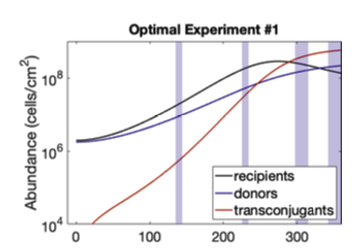
An example of the optimal experimental data. Graph by Nathan Braniff, PhD Candidate
Behaviour of bacterial communities. We're looking at baby versions of bacterial ecology. Bacterial ecology is very complicated and it’s very difficult to characterize what is going on in those systems. What we do in the lab is we set up very simple communities and start with characterizing their behaviours and working towards things that are more complicated. We are looking at things like horizontal gene transfer, phage infections, and more generically inhibition in terms of a diffusible toxin release from cells or a contact dependent effect. The tool we have for characterizing these systems is time lapse fluorescence microscopy. We have a set up that allows us to image the entire population in a single focal plane and we add fluorescent markers to these cells to indicate their state. We can run these experiments for twenty-four hours or more and we can watch the cells propagate and interact. What we have alongside that data is the characterization of the data in terms of these dynamic models. One opportunity is to use this modeling structure to understand how these systems behave, for instance to infer things like conjugation rate, growth rate, and effective conjugational growth. The goal here is to eventually use these models for model-based design of manipulation of these systems. These systems are in lots of different environments and being able to manipulate them sounds promising.
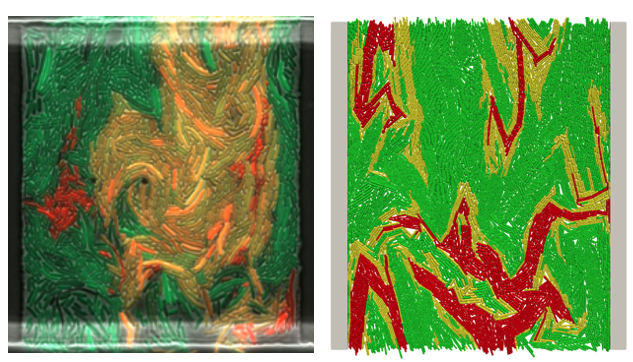
Image by Aaron Yip, PhD student.
You use mathematical and computational tools for your projects. Are these techniques common in synthetic biology?
The main mathematical tool the group uses is kinetic modeling to characterize system behavior and explore possibilities. That can be either the reverse engineering of systems to better understand what is there, or from a forward engineering perspective, model-based design. We can build models with some degree of accuracy in terms of prediction and that’ll allow us to explore design space much more cheaply than you could running batches and batches of experiments. I would say it's fairly common. There are lots of people that go into life science and have an aversion to computation. That's changing. There was a time when a lot of people in biology spent their whole careers and did very little computational work. The human genome project was a breakthrough for bioinformatics being identified as a key part of molecular biology. This kind of work is a bit more esoteric. Standard bioinformation is about things like genome analysis, sequence alignment, working with static data, and there's a lot of that data available. This kind of work requires more data to put these kinds of descriptions together. That kind of data is hard to collect, it is expensive to run these experiments so it's often not the first thing people do. I like to think it is becoming increasingly more common, but I wouldn't say it's very common. But there are lots of projects where it's an important piece and it's becoming a more valuable tool as people recognize that the data is available. The basic idea is that the systems are very complicated so in every other branch of science when you hit a really complicated system you need to turn to these tools to understand.
Are there any resources that Canada needs to help strengthen the field of synthetic biology? Where do you think Canada can improve?
Canada's economy is based on resource extraction which comparatively doesn't require a lot of R&D. That's been the basis for the economy since the country was founded. That is in part what has led to a sort of risk aversion in terms of investment, both private and public, so Canada is often lagging when it comes to new technologies and risky technologies. We do have certain strengths for sure. The educational system is great at producing people who can do this sort of work, and who are interested in this sort of thing. I think there's a lot of promise, and there certainly could be more delivery on that promise if we had more investment.
Are there any applications or techniques in the synthetic biology field that you’re excited for?
There's a lot of short term promise in biomanufacturing. Improving biomanufacturing is an iterative improvement, and so that does seem to be an area that the community is continuing to embrace as where there will be lots of impacts of synbio. One of the basic questions is about the release of organisms. So, if you're going to make an organism and you're going to use it, you have to set it free into the environment. People are understandably nervous about that. There are lots of discussions, and I don't think there's going to be any problem there. If you can have your advantage in the lab or the factory, and you never have to have that discussion, then it makes life a lot easier.
Do you have any advice for someone that wants to get involved in synthetic biology?
I could say two things. One is networking. There are groups and communities such as iGEM, and there’s always an opportunity to reach out. There are lots of opportunities to get involved even at the high school level. That’s something people should keep in mind. And the community is very welcoming and happy to have people interested at all stages. The other thing I would suggest in planning an education that could lead in this direction is being open and trying to embrace ideas across disciplines. A lot of educational programs are very siloed and disciplinary. Especially as an undergrad, that's how the program is set up and that's what you do. You take the courses you need to take. Seek out opportunities to expand that toolbox. Given that synbio is a relatively young field and a very interdisciplinary field, the best positioning one can have as a junior researcher, or someone interested in entrepreneurship is to get exposure to as many as those things as possible. So do a little bit of computing or entrepreneurship or life science or bioinformatics. Often one must be proactive about reaching out cause standard programs are typically very siloed and disciplinary.
Dr. Ingalls’ research in developing mathematical models is important for the field of synthetic biology. These models can help predict behaviours of intracellular networks and cellular communities, help build an understanding of complicated systems, and help further the progress of synthetic biology research

SynBio Canada Publishes Editorial “Facing the Paradox of Openness to Build Resiliency in Canada’s Bioeconomy"
Fabian Rohden (Science Policy Lead) and Dr. Benjamin Scott (President) have published a editorial as part of the Canadian Science Policy Centre’s 2022 series Building Resilience During International Crisis.
The editorial examines the paradox of openness, whereby the openness of nations is both the cause and solution to several ongoing international crises. This paradox also extends to Canada’s bioeconomy, where the openness of genomic data and infrastructure must be carefully considered.
Read our editorial to learn more: Facing the Paradox of Openness to Build Resiliency in Canada’s Bioeconomy.

The BioExperience Program
The BioExperience program was an interactive and collaborative learning experience in which teams of 6-8 undergraduate students from a wide variety of programs and faculties worked together on various self-guided projects related to synthetic biology. The 2020 BioExperience Program consisted of 7 different teams which investigated various topics ranging from removing microplastics from wastewater to creating a 3D bioprinter.
Hertek Gill - April 22, 2021

Design of the clarifier insert for wastewater treatment tanks created by the BioEnvo team and presented at the cGEM 2020 conference.
COVID-19 has affected the world in many ways but one effect of the lockdown that has hit university students hard was the sudden loss of many summer employment and co-op opportunities. Many students rely on these opportunities to fund their education and to gain vital job experience in their field of study. Due to the lockdown, many traditional student employers were, unfortunately, unable to host students over the summer. It was amidst these unprecedented times that Dr. Mads Kaern of the Faculty of Cellular and Molecular Medicine at the University of Ottawa started the BioExperience program with support from the University of Ottawa and BioTalent Canada. This new program would provide over 50 students the ability to work over the summer as well as the opportunity to gain the experiences and skills needed to initiate a career in biotechnology with an emphasis on the engineering of biological systems at the cellular and molecular level.
The BioExperience program was an interactive and collaborative learning experience in which teams of 6-8 undergraduate students from a wide variety of programs and faculties worked together on various self-guided projects related to synthetic biology. The 2020 BioExperience Program consisted of 7 different teams which investigated various topics ranging from removing microplastics from wastewater to creating a 3D bioprinter.
Students in the program were involved in every step in the research project from formulating the research question, creating a plan, interviewing and hiring other students, organizing and distributing the workload, and summarizing the results into publication-quality reports. This allowed for a large potential for growth as students learned to independently do the various tasks associated with running a research project.
The group setting with fellow undergraduate students created an environment where discovery and trial and error were promoted as everyone was learning how to organize and manage a research project together. This created a very collaborative and encouraging environment where everyone was able to speak during lab meetings and have their ideas considered. The inter-faculty nature of the groups also provided many students with their first exposure to working in interdisciplinary teams as most other group projects at the undergraduate level are done with peers in the same program. This allowed all the students to experience working with people with a completely different knowledge base and using these different backgrounds to the advantage of the group as a whole. This skill set will be very beneficial to all the students in future endeavors where they will have to coordinate with different departments at their place of work.
Another aspect of the program that was very influential in making the experience rewarding were the various training sessions held throughout the summer on topics such as doing research using the library’s virtual resources and how to cite work. These workshops helped teach important skills in an environment where they would be immediately applied, allowing students the opportunity to use and refine the skills without forgetting them.

COVID-19 testing kit designed by the COVID-ENG Team.
Throughout the summer each student conducted both self and peer-assessments of their fellow teammates. These assessments allowed students to understand their strengths and weaknesses so that they could understand what they could work on improving over the summer. Self-reflections were important as they allowed the students to think about what they have accomplished so far and what they personally see as their next steps. Students were then able to compare their reflection with the anonymous assessments their peers made of them to understand if they missed something. These moments of reflection ensured that everyone stayed on course over the summer and could utilize the remaining time to improve themselves as much as possible.
At the end of the 4-month program, every team submitted their work in a series of reports, schematics, and diagrams. The final day of the BioExperience Program was the Closing Ceremony. This one-day event featured presentations from each team, speaker panels as well as prizes for the various teams. This event was a culmination of everyone’s hard work and allowed everyone to showcase their work to their peers, faculty, and family.
After the summer, one of the BioExperience teams was chosen to present their work at the first annual Canadian Genetically Engineered Machines. Here the BioEnvo team was able to capture a gold medal and the award for the “Best Collaboration” for their close discussion with experts in the field, other research groups, and universities. The BioEnvo team consisted of 3 subteams which each worked on a different aspect of the project. The three sub-teams included the Microplastic Filtration sub-team, which designed a clarifier insert for wastewater treatment tanks; the Microplastic Remediation sub-team, which determined the necessary steps to process the collected microplastics, and the Microplastics Biodegradation sub-team, which focused on enzymatic processes to degrade microplastics. The final product of this project was a theoretical system that can remove microplastics from wastewater, using magnetite powder to create magnetic clumps of microplastics, which could then be easily collected. These collected microplastics would then be taken to a separate facility where they could be degraded by PETase enzymes inside a specifically designed Bioreactor facility.
The team not only focused on the science behind the project but also developed a viable business plan and pitch presentation to show potential investors. The pitch focused on the business aspect of the BioEnvo project and the benefits, both environmental and financial, that would come from the implementation of this project to remediate and recycle microplastics from the Ottawa River.
In the end, the BioExperience program was an experience like nothing else a student at the undergraduate level experiences in university. This program’s blend of problem-based learning with collaboration amongst an interdisciplinary team allowed every single student to develop many skills that will be vital to them in the job market. This program provided an experience that will have a profound impact on how students perceive the job market and their place within it. As a student who has experienced the first iteration of the BioExperience program, I would strongly encourage students to take the opportunity to be a part of this program as it will help them improve a multitude of skills and will leave them better prepared for anything that lies ahead. If your university does not offer such a program, strongly consider discussing this with the administration as a BioExperience-like program would be very beneficial to all students in terms of the experiences it provides to its participants.

An Interest in SynBio - The Perspective of a Canadian High School Student
I learned about synthetic biology 7 months ago, in September 2020. Over the summer, I first learned to code in Python, then in JavaScript, and now in Java. When I first heard about the development and application of computer science techniques to biology, I was hooked.
Ammielle Wambo Becker - April 22, 2021
Despair and anxiety are not uncommon feelings among young people these days. As high school students, we deal with many sources of stress, from parental pressure and high expectations to mounting workloads. It's not easy to juggle all this, not to mention the growing concerns about the future, whether it's because of the climate crisis or the coronavirus. But I am optimistic about one thing: synthetic biology.

https://pixabay.com/users/qimono-1962238/
I learned about synthetic biology in September 2020. Over the summer, I first learned to code in Python, then in JavaScript, and now in Java. I enjoy the creativity of debugging code and solving problems and the collaboration of participating in hackathons and competing as a team. When I first heard about the development and application of computer science techniques to biology, I was hooked. The exciting idea of programming a cell with the code of life, DNA, as I would with any other programming language, led me to biological computing.
Biological computing is concerned with the creation of biocomputers, i.e. biomolecules capable of performing calculations. I dove into DNA digital data storage and synthetic biological circuits as a way of demonstrating the computer-like properties of biological systems. Although I didn't know it at the time, I was just covering a small area of the field of synthetic biology.
I don't really know what about synbio is special to me. Maybe the field is just so emerging and I feel I can make a real impact. Maybe it's such a multidisciplinary and broad field that I don't have to choose a specialty yet. Maybe it's really a matter of optimism: synthetic biology shows great promise. Or it is a blend of all these reasons and more. I can see myself tinkering and engineering with biological elements for a long time.
I think the COVID-19 lockdowns have been both a blessing and a curse for my learning journey. On the one hand, more synthetic biology webinars and conferences are being held virtually than ever before, and thus I don't have to worry about cost or travel distance. I can gain invaluable insights and meet other people through Zoom! On the other hand, although I would love to gain the technical experience of working in a wet lab, I have never set foot in one. I’ve learned everything I know from articles, papers, and videos, as well as from insightful conversations with researchers and professionals.
It is often discouraging that so many opportunities and courses are reserved for post-secondary students, but I understand why. Because we lack the experience and knowledge to participate in technical courses and challenging events, high school students are rarely the target audience. Yet I always wonder why there are hardly any opportunities for us to get involved in biotechnology, to gain this necessary experience and knowledge. Few people around me (and even fewer people my age) have ever heard of CRISPR or synthetic biology. Despite the online learning content for beginners, entering this space can still seem intimidating and daunting to many. And even after taking the huge first step of outreach and awareness, I think that presenting enrichment materials and opportunities for a strong and diverse future biotech workforce is often missing. Even if young people know what synthetic biology is, how can they foster their interests? How can they pursue these fields beyond the classroom?
A good start would be to provide young people with mentorship and advice from researchers. I also think that research projects and placements play a key role in exposing students to potential career paths and supporting their interests. And why not launch courses with live lessons and virtual communities for young biotech enthusiasts across Canada to connect with others and share interesting articles and papers? Why not hold biotech challenges, case studies, or sprint-like events for students of all levels? While I cannot speak to the logistical or financial requirements of providing such opportunities, they could only empower young people to engage responsibly with synbio, to express diverse perspectives, to take an interdisciplinary approach, and to pursue careers in the Canadian bioeconomy.

SynBio Canada Publishes Policy Memo in the Journal of Science Policy and Governance
Canadian post-COVID-19 economic recovery efforts have been framed around values aligned with Canada's commitments to the United Nations Sustainable Development Goals (SDGs), primarily concerning environmental sustainability. The field of synthetic biology (synbio) offers many innovative ways to achieve these goals while growing the economy.

A policy memo drafted by members of the SynBio Canada Executive Team was recently published in the Journal of Science Policy and Governance. The memo entitled “Invest in Canadian Synthetic Biology to Meet Commitments to Sustainable Development and Support Economic Recovery” adds to the chorus of calls for dedicated funding of synthetic biology in Canada.
The memo was initially written before the COVID-19 pandemic, then updated many times to stress how important synthetic biology is for our future.
Abstract: Canadian post-COVID-19 economic recovery efforts have been framed around values aligned with Canada's commitments to the United Nations Sustainable Development Goals (SDGs), primarily concerning environmental sustainability. The field of synthetic biology (synbio) offers many innovative ways to achieve these goals while growing the economy. Here, we discuss the opportunity for Canada to become a leader in clean technology applications of synbio. Investments in synthetic biology, which has traditionally been underfunded compared to other countries, will have beneficial impacts on the environment while driving Canada's post-pandemic economic recovery.

cGEM Part II: The Workshops
While the cGEM 2020 conference provided a platform for Canadian iGEM teams to showcase their work, this event also fostered conversations on many aspects of synthetic biology with students, industry leaders, and academic professionals.
Fatima Sheikh - January 26, 2021
While the cGEM 2020 conference provided a platform for Canadian iGEM teams to showcase their work, this event also fostered conversations on many aspects of synthetic biology with students, industry leaders, and academic professionals. The conference was kicked-off by Dr. Bettina Hamelin from Ontario Genomics discussing the biological innovations that are being pushed forward as a result of the COVID-19 crisis. This inspiring keynote set the tone for what was 2 days filled with many different talks and important discussions on the vast applications of synthetic biology in Canada.
On day one there were a series of interactive workshops that allowed students to explore different avenues/aspects/components, important in the field of synthetic biology. The After iGEM team, directly from iGEM HQ, held an important workshop on scientific communication! To put it simply, research does not matter without effective communication. Scientific communication is required at every level of research whether it be in the beginning when acquiring funding, throughout while recording results, and especially at the end when relaying this information to stakeholders and the public. A strong emphasis in this workshop was put on knowing your audience. Is this information being presented to other professionals in the field, or is it being relayed to the public? Breaking down the language used is critical to ensure understanding of the material and knowing your audience can ensure that there are no misunderstandings. As members of the growing synthetic biology community, part of our responsibility is to ensure proper engagement of the public and this was highlighted by the After iGEM team and discussed throughout the remainder of the conference.
On day 2 we began with a series of fireside chats, one which included Dr. Benjamin Scott (SynBio Canada) along with Avalyne Diotte and Pierre Oliver (Policy Horizons) discussing what they’ve learned from the ongoing biodigital convergence webinar series. Together, they answered a number of questions and ultimately highlighted the potential of synthetic biology techniques and approaches that can be used to build on existing knowledge and infrastructure within Canada. But, how do we make this transition to the use of synthetic biology and its different applications in a way that engages all the important stakeholders? They suggested that part of it will come down to good science communication and with the recent pandemic, health and innovation are at the forefront of public discussion, providing scientists of all disciplines an important learning opportunity.
Later on during the day, a series of panels were held, one of which covered the topic of synthetic biology education. This conversation was moderated by Bi-ru Amy Yeung (cGEM co-director and co-founder), and included expert voices from Patrick Diep (CSBERG co-director and founder), Dr. Vincent Martin (Concordia), Magda Pop (MindFuel), and Orly Weinberg (Concordia). They highlighted the synbio education landscape in different regions of Canada and the progress that has been made over the past few years both at the high school and the post-secondary level. Moving forward, they encouraged the integration of project-based learning and re-framing human practices, referring to the social and ethical impacts of research, to improve integration with other domains of synthetic biology research. With students being an important part of the synthetic biology community future, a strong emphasis on educational programs that highlights both the technical skills along with other important aspects, such as science communication, will equip synthetic biologists with the tools to contribute to the bioeconomy.
This recap of the cGEM conference wouldn’t be complete without a discussion on the Equity, Diversity, and Inclusion in Synthetic Biology panel. It featured Dr. Trevor Charles (Waterloo), Kelcie Miller-Anderson (MycoRemedy), Dr. Nika Shakiba (UBC), and Peivand Sadat Mousavi (University of Toronto) and was moderated by Dr. Rebecca Shapiro (Guelph). Together, they fostered a discussion on roadblocks experienced by minorities and how each of them overcame their own obstacles. These individuals are inspirational, to say the least, with their stories providing proof that anything is possible with a strong support system. Suggested advice to young students and prospective synthetic biologists included making connections early and finding supportive mentors. Mentors can provide insights into how to elevate your career but are also important for navigating potential barriers. While there are strong efforts toward making the field of synthetic biology more diverse and inclusive, there is still a lot of work that needs to be done and will require each of us to do our part in creating a more equitable and diverse community.
This conference was wrapped up with a keynote by Dr. Ryan Pillipe from Genome Canada, where he shared insights into how students can contribute to the Canadian bioeconomy, followed by reflections from Amy Yeung (UofT), Jehoshua Sharma (Guelph), and Luana Langolis (Western) on the conference and future of synthetic biology. We think it’s safe to say this year's conference was a success, and while we only highlighted a few sessions from the conference, every session had fostered important discussions between students, researchers and industry professionals. As we continue to grow this community and leverage synthetic biology to improve society, effective knowledge translation and engagement of the public as well as active efforts to create a more equitable and diverse community, are going to be important drivers of this growth.
Thank you to everyone who attended this conference, if you missed any of the amazing sessions you can find the recordings on the cGEM Youtube Channel. Be sure to keep an eye out for next years events and initiatives by following @cGEM_2020
List of cGEM 2020 Workshops
Pitch Fundamentals by Forest City SynBio
Scientific Communication by After iGEM
Scientific communication is extremely important with 6 main keys
Stakeholders: people depending on the research
Scientific method: this includes disseminating results
Public perception
Funding
Communication skills
Sustainability
Lean Business Model Canvas by Danielle Rose from SynBio Canada
Translational Synbio by Synlogic
Inscripta Keynote by Chad Whitman
Biodesigning our Future by Ginkgo Bioworks
Digital Bioconvergence by Synbio Canada and Policy Horizons
Community Science by Open Science Network
Equity, Diversity, and Inclusion in SynBio Panel
Environmental Sustainability in SynBio Panel
Canadian Start-Ups in SynBio Panel
Canadian Education in SynBio Panel
Genome Canada Keynote by Ryan Philippe
cGEM Keynote by Jehoshua Sharma, Amy Yeung, and Luana Langlois

cGEM Part I: The Teams
The first-ever Canadian iGEM (cGEM) conference was held on October 3rd and 4th. With over 240 participants registered, 10 iGEM teams presenting, 4 workshops, multiple panels, and keynote speakers, this event fostered important synthetic biology discussions.
Nicole Leblanc - October 29, 2020

While many events and conferences were cancelled this year due to the pandemic, the first-ever Canadian iGEM (cGEM) conference was held on October 3rd and 4th. With over 240 participants registered, 10 iGEM teams presenting, 4 workshops, multiple panels, and keynote speakers, this event fostered important synthetic biology discussions. This inaugural trainee-led conference was organized by iGEM members across the country, led by iGEM alumni and synthetic biology enthusiasts, Jehoshua Sharma, Bi-ru Amy Yeung, and Luana Langlois who saw a need for a trainee-focused synthetic biology conference.

The year of 2020 will certainly be remembered for generations to come as the time when ‘unprecedented circumstances’ interfered with plans for the future on a global scale. This was no different for Canadian iGEM teams as many were forced to make the difficult decision to not participate in the (rather expensive) international competition this year.
Having recognized the educational value of the experiential learning opportunity facilitated by the iGEM competition, the cGEM steering committee sought to develop an all-Canadian version of the competition at no cost, which aims to contribute to the creation of training opportunities for young trainees in the country and better reflects the organization’s values: academic ingenuity, entrepreneurship, fostering public trust, and promoting interdisciplinary action. To this end, the organizers developed their own judging criteria, which placed a stronger emphasis on entrepreneurship. Also, many teams were unable to access labs as they normally would and so the cGEM competition criteria was focused on project design, collaboration, and peer review.
The cGEM criteria was used to judge the teams not participating in the iGEM competition, while the teams attending the online iGEM jamboree were judged by the iGEM Medal criteria so as to minimize the duplication of efforts for the latter teams. From the teams that are not participating in the iGEM competition this year, three teams were awarded a gold medal, the University of Guelph, the University of Ottawa, and the University of British Columbia, one team was awarded a silver medal, McMaster University, and one team awarded a bronze medal, the University of Toronto.

Of the teams that are participating in the iGEM competition this year, there were 2 teams awarded a gold medal, the University of Waterloo and Queen’s University, one team awarded a silver medal, Lethbridge Collegiate, and two teams awarded a bronze medal, University of Calgary and Lethbridge high school. In addition to medals 4 special awards were given out including best academic innovation to McMaster University, best entrepreneurship exploration and best scientific communication to University of British Columbia, and best collaboration to the University of Ottawa
With synthetic biology-based projects ranging from engineering various crops to developing software to help predict vaccine targets, the iGEM teams demonstrated a breadth of knowledge that can be readily applied to address imminent global and local issues, leaving all of the attendees nothing but impressed. Have a look below to see what each team worked on! More information including project presentations can be found at the cgem2020.ca website.
The Teams
McMaster: Built a mathematical model of a bacterial population carrying antibiotic resistance genes subjected to sustained antibiotic pressure due to the antisense oligonucleotide (ASO)-mediated silencing of antibiotic resistance genes! They also worked on validating the time to failure, frequency of specific and non-specific mutations that lead to resistance and explored clinical trials to better understand ASO cytotoxicity and patient adherence.
Guelph: CRISPR for Climate Resistance. They are working on controlling the expression of plant genes such as cold tolerance genes or drought resistance genes to enable the plant to survive in harsh conditions. Also, in an attempt to democratize science, they have designed an affordable shaking incubator and with further testing, intend to make this model available to other iGEM teams so they can build their own too.
Ottawa: Developing a solution to remediate plastic pollution in freshwater environments. By developing a bioreactor and utilizing a plastic degrading enzyme, PETase, water from wastewater treatment plants can be more thoroughly processed and plastic extraction can be improved. The broken down plastic could be recycled and used to make biogas or more plastic products.
Toronto: Generating more efficient plastic-degrading enzymes by combining rational design and machine learning. The team has proposed a bioreactor for textile recycling in Toronto, diverting them from landfills, by generating more stable and efficient variants of current plastic degrading enzymes, such as PETase, MHETase, and LLC, and integrating these into E. coli.
UBC: Designed VPRE (Viral Predictor for mRNA Evolution), a software tool that simulates evolution to predict genetic mutations in viruses. Applying this software to emerging viruses, the evolution of protein sequences can be predicted and can help inform pre-emptive vaccine development that targets conserved viral proteins.
Lethbridge Collegiate: Engineering potatoes to express antimicrobial peptides as a solution to problems concerning agriculture. Having potatoes express antimicrobial peptides effective against Fusarium fungi, would eliminate the issue of infections during potato storage. Another possibility is to express antimicrobial peptides with known health benefits to help boost consumers' immune systems, increasing public resilience in the event of a pandemic.
Calgary: Developed, OVIITA, a food-safe beta-carotene rich strain of yeast that is modified to secrete enzymes to increase beta-carotene production and to help combat poor vitamin absorption for the prevention of Vitamin A deficiency. This would empower communities to cultivate their own renewable source of vitamin A locally. The team has also developed the Randle cell, a portable Vitamin A deficiency diagnostic device.
Lethbridge High School: Designed tPectinACE, Targeting Pectin to Accelerate Compost Enzymatically, a synthetic system to accelerate compost degradation. The team aims to create a system that can be utilized in households and in large-scale composting facilities to help eliminate the methane gas produced from composting which contributes to climate change.
Queens: Developed a biosensor for the quantification of chronic kidney disease (CKD) biomarkers such as parathyroid hormone and fibroblast growth factor 23. The current monitoring method in Canada is through blood samples every 6 weeks and this time frame makes it difficult to provide patient-specific treatments. The biosensor would allow for frequent monitoring and early CKD detection, leading to better patient outcomes.
Waterloo: Designed REMINE, a column bioreactor with metal-binding proteins to remove toxic heavy metals from electronic manufacturing wastewater. This also allows for heavy metal recycling as they are very valuable. REMINE system can be customized to target specific metals, making it adaptable to the environment it is used in.
Best of luck to Queen’s, Waterloo, Lethbridge Collegiate and high school, and Calgary upcoming iGEM competition, we know you will make us all proud! And make sure to keep an eye out for Part II of our cGEM summary coming soon.

Bringing SynBio to the Classroom: BioBits™ Bright
BioBits Bright, is a just-add-water synthetic biology kit where cell-free reactions are used to express fluorescent compounds as visual stimulation, jointly worked on by UofT synthetic biologist Dr. Keith Pardee.
Danielle Serra - February 27, 2020
During my K-12 education subjects such as mathematics, biology, and art were always taught separately, with little interaction between them. But in the real world, problems and projects are rarely so focused on a single discipline, which is why interdisciplinary teaching and problem solving serves as a unique and important opportunity for students well before they enter post-secondary school. Synthetic biology tools are well suited to interdisciplinary teaching in classrooms, as they intersect many areas of study such as life sciences, engineering, and design.

Figure 1: BioBits™ Bright is a synthetic biology learning kit that provides exposure to molecular biology and engineering techniques at a beginner level of understanding (Reprinted from [Science Advances] Stark et al 2018).
The creation of an educational biology kit, jointly worked on by University of Toronto synthetic biologist Dr. Keith Pardee, will enrich a student’s educational experience by exposing them to biological engineering techniques. BioBits™ Bright, is a just-add-water synthetic biology kit where cell-free reactions are used to express fluorescent compounds as visual stimulation. Classrooms are typically limited in the projects that can be performed such as due to biosafety regulations, cost, or availability of equipment. By addressing such limitations, students can further their engagement in biology by using this kit.
BioBits™ Bright
This educational kit offers a low-cost opportunity for schools to implement synthetic biology into their curriculum. Designed to be user-friendly for any untrained operator, BioBits™ Bright uses FD-CF (Freeze-dried, cell free) reactions which synthesize protein in vitro. FD-CF reactions work by introducing freeze-dried pellets that contain many of the biological components that exist in living cells such as RNA polymerase or translation initiation factors, without the need for actual living cells. FD-CF reactions are also stable and can be performed at room temperature without compromising the results of the experiment. A library of 6 main fluorescent protein variants as seen in Figure 1(A), were chosen as the main fluorescent colours for individual expression. Students are then able to visually link molecular concepts and ask deeper questions as to how they may occur.
Two modules were developed for use with the FD-CF reactions and the fluorescent variants as the core components for BioBits™ Bright.
Module I: Changing the level of fluorescence
This first module helps students to understand protein synthesis. As seen in Figure 1(B), various concentrations of DNA template are titrated to the FD-CF reactions. By allowing the students experiment with the different concentrations of DNA template, they should come to the conclusion that there is a link between the amount of DNA template and the level of florescence that is ultimately produced. This experiment allows students to better grasp the idea of the central dogma in molecular biology by conceptualizing the idea that DNA template may act to initiate protein synthesis. The levels of florescence as the outcome for Module I, qualitatively teaches students that DNA plays an important role in the ability to produce protein.
Module II: Designing, building, and testing

Using BioBitsTM Bright, the design, build, and test cycle is implemented to create unique designs using varying levels of fluorescence (Reprinted from [Science Advances] Stark et al 2018).
Module II next enables students to build upon their knowledge from Module I and create their own in vitro project. Introducing the design, build, and test (DBT) cycle, it will introduce students to synthetic biology and engineering concepts (Figure 1(C)). Students will be able to rehydrate the FD-CF reactions with any of the 6 main fluorescence variants and any desired amount of DNA template in order to produce the required fluorescence to build their project. During the first trails of Module II, participants were given the creative freedom to construct their own in vitro program. As seen in Figure 2, some participants created designs resembling things like the rainbow, the periodic table, or even Connect Four®!
Built for accessibility, BioBits™ Bright will help engage students in the classroom and introduce them to the field of synthetic biology. By allowing the student to produce a project of their interest, the end result will combine biology with art and creativity.
For more information about BioBits™ Bright, check out https://www.mybiobits.org
References
Stark JC, Huang A, Nguyen PQ, et al. BioBits™ Bright: A fluorescent synthetic biology education kit. Science Advances. 2018; 4(8). https://advances.sciencemag.org/content/4/8/eaat5107

BioSynSys in France
In November I had the opportunity to attend Bio SynSys in Bordeaux, France as the representative for SynBio Canada. We were invited to participate in a panel discussion featuring members from a number of Synthetic Biology Organizations.
Danielle Rose - February 3, 2020
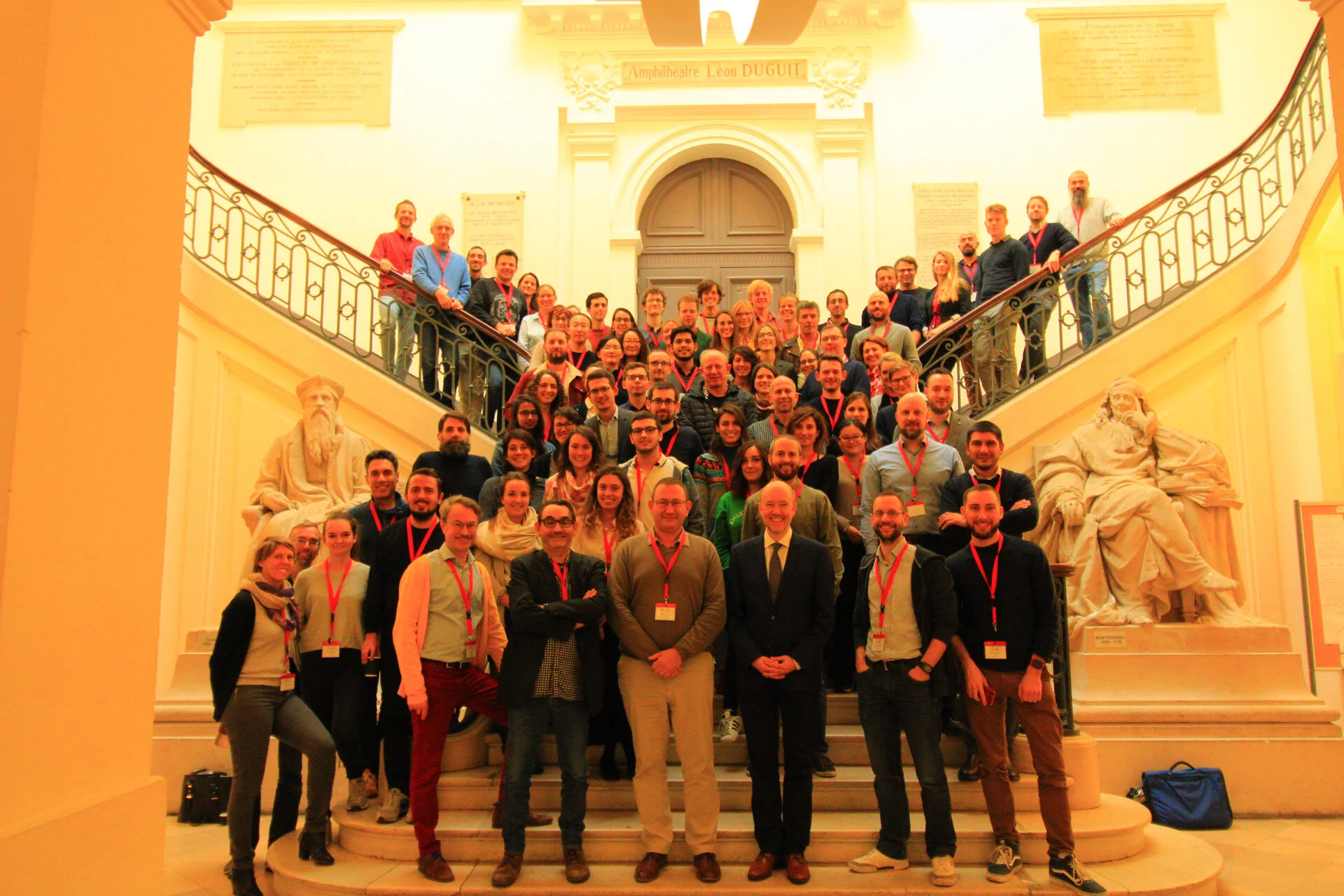
Group photo of Bio SynSys attendees - photo by Danielle Rose
If you want to learn about cell free, Bio SynSys is the place to be.
In November I had the opportunity to attend Bio SynSys in Bordeaux, France as the representative for SynBio Canada. We were invited to participate in a panel discussion featuring members from a number of Synthetic Biology Organizations (including France, Europe, Germany, and the UK). Bio SynSys is a joint effort between the German and French SynBio Organizations (including the Max Planck SynBio research group and SynBio France) to showcase the exciting research going on in these two countries.
Backdropped by beautiful French architecture ensued 3 days of inspiring talks on topics ranging from microfluidics to re-designing the plant photosynthetic pathway. Thanks to the Max Planck Institute’s focus on bottom up biology, I got a crash course in cell free systems and the awesome opportunities they open up with regards to rapid pathway optimization.
As the conference continued, I got to hear some amazing talks, but one in particular has still stuck with me. Every once in awhile when you attend an event like this you hear a talk that make you giddy with excitement at the amazing new potentials for the field that have appeared before your very eyes. The talk by Marieke Scheffen from the Max Planck Institute for Terrestrial Microbiology was without a doubt one of these. Through her presentation she brought us through the steps her team had taken to engineer a completely novel carboxylase not found in nature in order to develop a new biosynthetic pathway. And, if this wasn’t cool enough, the newly developed tartronyl-CoA (TaCo) pathway is already being used by a partner company to improve the way that plants conduct photosynthesis, eliminating carbon waste.
It was really cool to share what we are working on in Canada at an international conference, and it was exciting to see all of the work being done across the world by other SynBio organizations. Our panel discussion resulted in an interesting chat about what is needed in the years to come with regards to education for those wishing to pursue a career in SynBio. The debate mainly came down to whether or not it was better to have a program specifically designed for engineering biology, or if the field was too multidisciplinary and broad for this to work and if we should just focus more on fostering independent learning through easier to access materials online.
As the conference drew to a close I said au revoir to the new friends I had made and headed back to Canada, armed with new ideas on how to improve our synbio community. As different as our countries are it's exciting to see how similar the synbio community is across the world, and it really inspires me for what we will be able to accomplish in the years to come.


CSBERG: Developing SynBio Education
CSBERG is a graduate student-led “teaching R&D” program for synthetic biology at the undergraduate level. We consist of iGEM Toronto/Calgary/Waterloo alum (many now graduate students), BioZone graduate students, and colleagues from multiple universities in Ontario and Québec.
Patrick Diep - December 13, 2019

The Canadian Synthetic Biology Education Research Group (CSBERG) logo - contributed by Patrick Diep
I believe it was on Twitter when I saw someone tweet that synthetic biology (synbio) was a subject that should stay within the realm of graduate students and postdocs in academic research labs because it was “too hard for undergrads”. This is a common sentiment in synbio, and it wasn’t my first time hearing it, but it struck a nerve because I was heading to Boston in a few months for my third time judging for iGEM (International Genetically Engineered Machine, an annual synthetic biology design competition) . I thought about how iGEM was my entry point for research during my undergraduate studies and about how awesome some of these iGEM projects can become. I’ve attended five iGEM jamborees now and have had the chance to witness how synthetic biology projects flourish from high school, undergraduate, and overgraduate (i.e. graduate student-based) teams. Synbio is not too hard for undergrads.
Gatekeeping synthetic biology hampers its big promises to help tackle a variety of issues in fundamental science and real-world issues. I understand the opinion that one needs to enter synbio with their own expertise in order to more effectively work with other experts, and having a specialized undergraduate program helps with that. But instead of restricting access because of the “too hard for undergrads” notion, maybe we can consider whether there is anything we can change at the undergraduate level to make the transition to synbio graduate work and industry more streamlined. Not multidisciplinarity, but interdisciplinarity.
So, I asked myself a big question: how does one teach a highly interdisciplinary subject to a mixed audience composed of undergraduates from experimental, computational, engineering, social sciences, and humanities backgrounds? Participating in the iGEM competition provides students with a strong situated learning experience where students from all these backgrounds must work together to fulfill the iGEM competition medal criteria, but there is limited research that explores the learning dynamics in iGEM design teams. Based on conversations with iGEM judges and professors, and my own observations, iGEM undergraduate alum become excellent graduate students. How can these success stories be translated into elements of synbio curriculum design within and beyond iGEM?
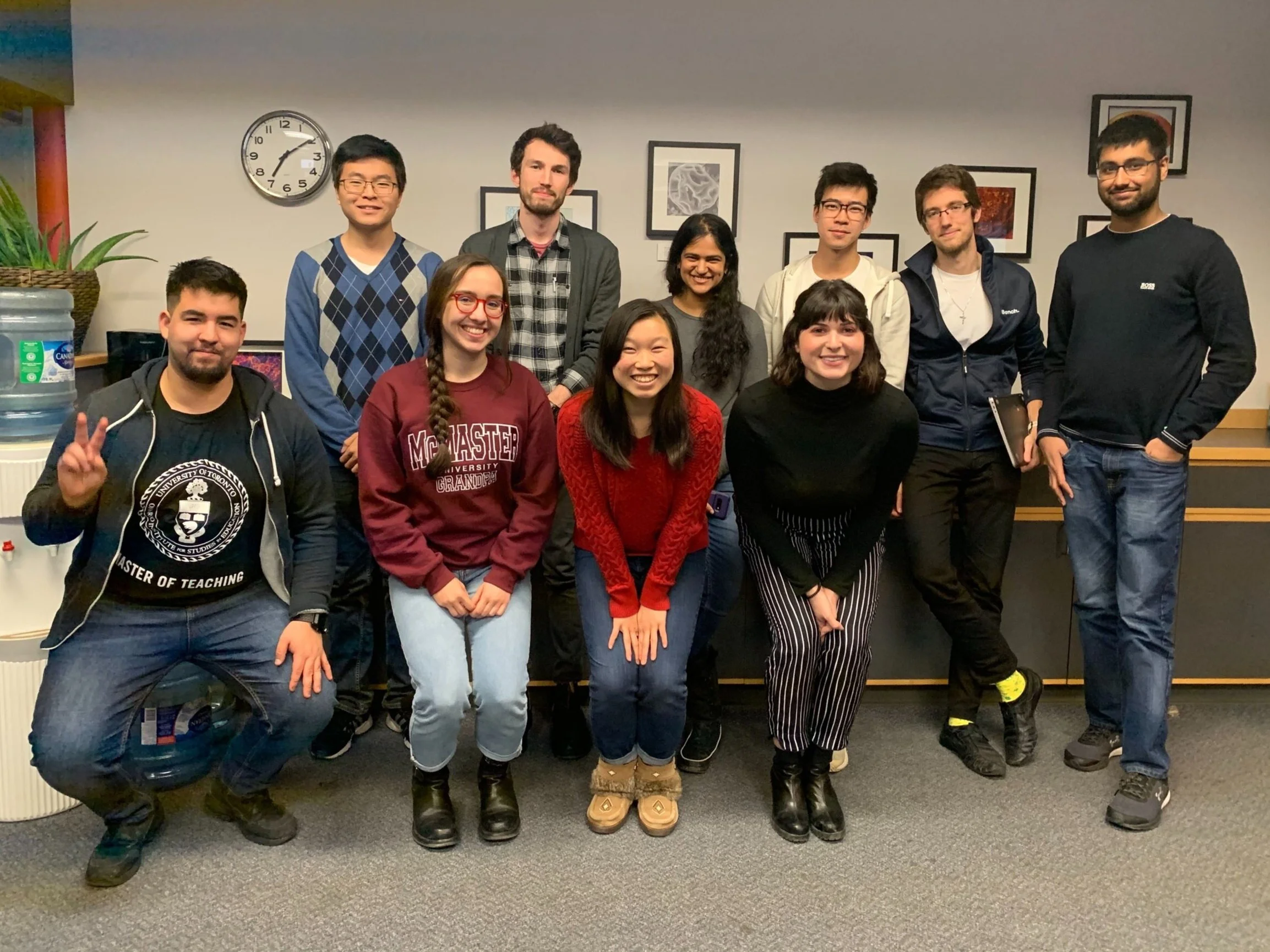
The CSBERG Instructor Team - contributed by Patrick Diep
I decided to investigate this big question, but I knew I could not do it alone. With Katariina Jaenes’ help, a colleague and friend from Professor Keith Pardee’s lab, we created and delivered an introductory synbio workshop to the undergraduate iGEM Toronto design team at UofT, in May 2019. It was well-received, but we learned very fast that teaching synthetic biology requires a team of experts, and that two experimentalists like us could not pull it all off. So, I later formed the Canadian Synthetic Biology Education Research Group (CSBERG) in August to investigate this question. CSBERG is a graduate student-led “teaching R&D” program for synthetic biology at the undergraduate level. We consist of iGEM Toronto/Calgary/Waterloo alum (many now graduate students), BioZone graduate students, and colleagues from multiple universities in Ontario and Québec.
CSBERG has a clear deliverable that everyone on this team is working toward: a 1-month intensive workshop series (May-June 2020) to teach a mixed audience the knowledge and tools required to plan and execute a synthetic biology design challenge. Based on our collective understanding of synbio at the graduate level and from previous iGEM competition experience, we are placing a special emphasis on developing leadership, teamwork, communication, and collaborative skills to empower the students to work better in groups. We are also placing a special emphasis on integrating the various topics that we will be teaching so that students can understand how tools in other disciplines are used. To guide us in developing the specific workshop content, we are conducting a survey of all 2019 Canadian iGEM design teams to identify educational gaps that we could address in our workshop series. Finally, to gauge our teaching effectiveness, we are designing educational experiments with assistance from OISE (Ontario Institute of Studies). All this work will go through the Office of Research Ethics (at UofT) for approval, and we hope to publish our findings for our stakeholders.
Overall, CSBERG’s existence is a response to the notion that synbio is “too hard for undergrads” – it’s not. More time and concerted effort must be put into critically breaking apart traditional pedagogy for related disciplines (e.g. biochemistry, molecular biology, bioethics, chemical engineering, etc.) and re-building it with contemporary teaching strategies and integrated feedback from relevant stakeholders. We envision our work informing the development of upper-year courses that help senior undergraduate students interface their speciality knowledge and tools with those of other experts in order to address synthetic biology design challenges from an interdisciplinary approach.
To keep up to date with our work, we encourage you to follow us on Twitter. CSBERG values far-fetched untested teaching ideas (we literally have a document for this), so if you’re especially passionate about teaching courses/content related to synbio, we invite you to message us at csberg.biozone@gmail.com for support, or perhaps a collaboration! We are also looking for financial sponsors and advisors (i.e. principle investigators) to support the growth of CSBERG, so please e-mail us if you are interested.
Cheers,
Patrick
Patrick Diep is a 3rd year PhD student under Professors Krishna Mahadevan and Alexander Yakunin in BioZone, a bioengineering cluster in the Department of Chemical Engineering and Applied Chemistry at the University of Toronto. He is genetically engineering microbes to remove and recover heavy metals from mine wastewater and is program director for CSBERG, which also provides oversight for the revitalized iGEM Toronto design team.

iGEM 2019: 15 more reasons Canada is moving mountains in synthetic biology!
Our Canadian iGEM projects are mostly self-funded, and completely extra-curricular, with passionate students who clearly want more than sitting behind their desks. This is what iGEM has given our students, from fifteen Canadian institutions. This is also the first time in history a Canadian team is a finalist - Calgary being first runner up in the undergraduate division. Canada has never performed this well at a Jamboree!
Kenza Samlali - December 12, 2019

iGEM 2019 Judging Panel. (Picture: iGEM Foundation, Justin Knight)
How many biology degrees offer students an opportunity to collaborate with other disciplines, or design and perform lab group work at all? I know that during my undergrad I never had the chance to design my own experiments, let alone collaborate with students from other faculties. This is traditionally reserved for your Masters thesis or PhD work.
But what happens if you build a support network for (under)graduate students from all over the world who wish to do so? The field of synthetic biology seems to be the ideal testing ground for such an activity, covering engineering principles, characterization, standardization, safety and human practices.
Luckily, I’m about 16 years late with this idea, and the reason why synthetic biology is built on these elements, is partially thanks to groups of students taking part in iGEM. Since its inception in 2003, the iGEM organization (international genetically engineered machine), has played an important role in the education and structure of the field of synthetic biology, turning the focus on multidisciplinarity and engineering principles to address critical problems in our community with synthetic biology. With a yearly competition - the international genetically engineered machines (iGEM) competition - iGEM stimulates hundreds of (under)graduate and high school students worldwide to complement their education with a self chosen self-directed project.
The importance of iGEM in the field of synthetic biology can’t be understated. The freedom an iGEM project hands to undergraduate students leads them to learn design thinking strategies, fundraising, marketing, hardware and software design, communication skills and long-term planning. The methods of teaching and training promoted by iGEM, in the shape of a fully student-run multidisciplinary project, develop sharp minded students with soft skills a traditional scientific education would never offer them. Many companies originated from iGEM projects, and the ‘AfteriGEM’ network has been able to send ex-iGEMers to important international conferences where the iGEM community is invited, being experts in the field.

Calgary’s excitement after the announcement of their finalist prize. (Picture: iGEM Foundation, Justin Knight)
This year, 14 Canadian collegiate teams and 1 Canadian high school team were accepted to participate in the iGEM Giant Jamboree at the Hynes Convention Center in Boston, a gathering of teams from all over the world marking the end of the yearly competition. From October 31st to November 3rd, the teams presented their work to fellow iGEMers and an expert judging panel. Again, this year I had the pleasure to be part of this judging panel. In total, nine Gold medals, two silver medals, two bronze medals, 4 awards and numerous additional nominations were awarded to the Canadian teams. This is also the first time in history a Canadian team is a finalist - Calgary being first runner up in the undergraduate division. Canada has never performed this well at a Jamboree!
Our Canadian iGEM projects are mostly self-funded, and completely extra-curricular, with passionate students who clearly want more than sitting behind their desks. Something is happening and students can’t sit still anymore. We want to build, invent, run companies, collaborate, and be believed in. This is what iGEM has given our students, from fifteen Canadian institutions. Canadian students want to shake up the way they learn, leaving an impact on our communities. I’m extremely excited thinking about how far this generation will move the field of SynBio, with a little bit of flexibility and increasing support from our education system.
Congrats to all teams!

UBC students explaining their project to a judge during poster sessions. (Picture: iGEM Foundation, Justin Knight)
Award Summary
1 Finalist
9 Gold, 2 Silver, 2 Bronze medals
Best Food and Nutrition Project, Best New Application, Best Software Tool, Best Integrated Human Practices Undergraduate
Teams Overview
Medal: Gold
Project: UBC developed a method to prevent paralytic shellfish poisoning (PSP) - a neurotoxic illness that has devastated coastal indigenous families that rely on seafood as a main diet.

Calgary during their final presentation on stage - (Picture: iGEM Foundation, Justin Knight)
Project: Flip recombinase activity is binary and thus cannot be precisely activated in time and space. Utilizing light-sensitive protein interaction domains termed “magnets”, the Brock University iGEM team has developed a light-sensitive optogenetic variant of Flip recombinase that can be controlled in Escherichia coli with exquisite spatiotemporal precision.
Finalist, first runner up, Undergraduate
Awards: Best Food and Nutrition Project, Best Software Tool, Best Integrated Human Practices Undergraduate
Award Nominations: Best New Basic Part, Best, New Part Collection, Best Model, Best Poster, Best Presentation, Best Supporting Entrepreneurship, Best Wiki
Medal: Gold
Project: Calgary addressed the green seed problem - a big problem in the Canola oil industry. Green canola seeds causes financial harm to farmers and oil producers. The team tackled several parts of the Canola oil manufacturing pipeline: improving seed production with a weather predicting program, improving grading practices with hardware to calculate seed grade, produced 6GIX enzymes for extraction of chlorophyll and designed improved variants, and designed several enzymes to convert chlorophyll into an anti-fungal peptide.
Awards Nomination: Best Presentation
Medal: Gold
Project: The Concordia team set their eye on Fentanyl, an opioid painkiller, and the leading cause of accidental opioid overdose as many recreational drugs users are unaware that their drugs are laced with it. Quantifen, as the Concordia team calls it, is a non-invasive wearable biosensor based on a yeast biosensor, for the detection of fentanyl in sweat.
Medal: Gold
Project: Team Guelph University developed an antibiotic biosensor as to measure Tetracycline in animal products, to tackle the problem of antibiotic use in the livestock industry. E. coli was used as a model organism, turning pink upon the detection of tetracyclin.
Medal: Gold
Project: Lethbridge tackled a problem the pharmaceutical industry has dealt with for a long time: oral delivery of insulin. By using a microalgae called C. merolae, the team was able to solve this problem. By engineer an insulin metaboilic pathway in it, these acid pH resistant algae can now be ingested.

Students of Lethbridge High school explaining their project. (Picture: iGEM Foundation, Justin Knight)
Medal: Silver
Project: Canada’s only high school team decided to use CRISPR to build a diagnostic system that could identify pathogens and provide accurate antibiotic treatments, thus decreasing the misdiagnosis and spread of antibiotic resistant bacterial strains.
Project: Northern British Columbia team is the second team this year that decided to chose to address the opioid crisis. They built an opioid biosensor in Saccharomyces cerevisiae that can be used to test non-opioid recreational drugs for opioid contamination prior to consumption.
Awards Nomination: Best Diagnostics Project
Medal: Gold
Project: The Queens team designed a novel portable immunoassay to detect tetrahydrocannabinol (THC) – the active ingredient in marijuana. They used recombinantly expressed antibody fragments, which are conjugated to fluorescent molecules.
Awards Nomination: Best Manufacturing Project
Medal: Gold
Project: Toronto designed circularised PETase enzymes for PET hydrolysis into environmentally-harmless terephthalic acid (TPA) and ethylene glycol (EG) outside the cell. They additionally developed new methods to generate thermostable PETasemutants.
Medal: Bronze
Project: The UAlberta iGEM team created a portable detection system to replace the current time consuming detection method of Nosema ceranae disease in honey bees. They did so by designing a system comprised of M13 phage labelled with a chromoprotein and displaying a ligand specific to N. ceranae spores. Based on the colour intensity of the diagnostic paper strip, the severity of the hive infection can be assessed, thus democratizing diagnosis and facilitating effective treatment of N. ceranae.
Awards: Best New Application
Award Nomination: Best Model
Medal: Gold
Project: Team ULaval created a device, called A.D.N. (Airborne Detector for Nucleic acids, DNA in French) to rapidly detect small concentrations of airborne pathogens. The device relies on a novel microfluidics-based DNA extraction method, and detection of target DNA sequences by molecular sensors.
Medal: Gold
Project: The University of Ottawa team wished to tackle the obstacles of the lack of expertise and financial constraints many iGEM teams have. They have produced easy-to-read and video protocols, and multiple BioBrick library that offer compatibility with E.coli and yeast, or Golden Gate assembly.
Medal: Silver
Project: The Waterloo team engineered rhizospheric soil bacteria Bradyrhizobium diazoefficiens USDA110 to have the ability to form root nodules with soybeans in the presence of the herbicide linuron. Usually, herbicides have a negative effect on rhizobia, which offer nitrogen delivery to most farmed plants, reducing the need for fertilizers.
Medal: Bronze
Project: At Western, students developed a versatile platform for the degradation of a wide range of emerging contaminants consistently found in wastewater. They did this using a self-assembling catalytic bacterial biofilm capable of degrading these contaminants.
Check out last year’s Canadian team’s performance in our blog post here.

Synthetic Biology at the University of Toronto: Medicine by Design and Beyond
Medicines are going to be made by design and synthetic biology is going to be a key enabler to realize these new approaches in medicine. Medicine by Design is not only a promising concept; it is also the name of an initiative at the University of Toronto (U of T) that aims to accelerate this new era of medicine.
Laura Prochazka - October 28, 2019
Medicine is entering a new era where chemicals will be replaced with engineered cells that perform human defined functions; where transplants from human donors will be replaced with de novo (in the laboratory) engineered tissues and organs; where damaged tissues and organs will be regenerated inside our body; where diagnostics will detect diseased states prior to appearance of symptoms; and where our genome is edited to prevent incurable genetic diseases. Medicines are going to be precise, safe, preventative and curative. Medicines are going to be made by design and synthetic biology is going to be a key enabler to realize these new approaches in medicine.

Figure 1: Medicine by Design banner. Photo credit: Neil Ta
Medicine by Design Invests in Synthetic Biology

Figure 2: (a) Attendees of the MbD Synthetic Biology Discussion Group and (b) how they define / think about synthetic biology
Medicine by Design is not only a promising concept; it is also the name of an initiative at the University of Toronto (U of T) that aims to accelerate this new era of medicine. Medicine by Design is funding early-stage and translational projects in primarily regenerative medicine. It also sponsors post-doctoral fellowships and travel awards, offers communication-, career- and commercialization workshops, and much more. Importantly, the initiative also invests in synthetic biology. For example, it helped launch the Medicine by Design Synthetic Biology Discussion Group, which takes place once per month alongside the Single Cell, Organoid and Computational Discussion Group meetings. The Medicine by Design Synthetic Biology Discussion Group has more than 140 subscribers, including students, post-doctoral fellows and professors at U of T, as well as professionals from industry and government (Figure 2). The event offers a space to present work, discuss synthetic biology-related topics, start collaborations and, not to forget, enjoy Medicine by Design sponsored pizza. For more information, please see below the summary of past discussion group meetings. It gives a good overview of synthetic biology-related work that is currently happening at U of T.
Other efforts include bringing synthetic biology closer to high-school students with booths at the Regenerative Medicine Expo or financial support of the U of T’s iGEM team. Medicine by Design has also supported the hiring of several new faculty members with expertise in synthetic biology, including Prof. Keith Pardee in the Leslie Dan Faculty of Pharmacy (cell-free synthetic biology), and Prof. Leo Chou (DNA nanotechnology) and Prof. Michael Garton (mammalian synthetic biology) at the Institute of Biomaterials & Biomedical Engineering. Finally, Medicine by Design is funding interdisciplinary projects that integrate the expertise of those new faculty and more senior synthetic biology faculty, including Prof. Krishna Mahadevan (Metabolic Systems Engineering).
A short summary of previous and future MbD Synthetic Biology Discussion Group meetings:
2018
February 28th Dr. Benjamin Scott, former PhD student Belinda Chang lab, current postdoctoral associate at the National Institute of Standards and Technology (NIST) in Washington DC “Studies of Human GPCRs Using Yeast” & “The Goals of SynBio Canada”
March 27th Dr. Trevor McKee, Group leader at the Computational Pathology core facility at STARR “Moving from Images to Data: Resources and expertise in computational pathology at the STTARR core facility”
April 24th Dr. Brendan Hussey, former PhD student David McMillen lab, current postdoc “Programmable T7-based synthetic transcription factors”
June 26th Aaron Trotman-Grant (MSc Student Dana Philpott lab) & Laura Prochazka (Postdoc Peter Zandstra lab) “Trends in Mammalian Synbio: Take home massages from the 5th International Mammalian Synbio Conference”
July 31th Ashton Trotman-Grant, PhD student Juan Carlos Zuñika-Pflücker lab “Designing ‘Smart’ Immune Cells to Expand Therapeutic Capabilities”
August 28th Christian Euler, PhD student Krishna Mahadevan lab “Reverse and Forward Engineering: Modeling Real and Synthetic Systems”
October 30th Kaushik Raj, PhD student Krishna Mahadevan lab “Emergent properties in gene regulation”

Figure 3: Self-identification and interest in synthetic biology among the participants of the MbD Synthetic Biology Discussion Group
November 27th Dr. Keith Pardee, Assistant Professor at Leslie Dan Pharmacy Faculty “Rapid, Low-cost Tools for Human Health”
2019
March 26th Dr. Leo Chou, Assistant Professor Institute of Biomaterials and Biomedical Engineering (IBBME) “What can DNA nanotechnology do for synthetic biology”
April 30th Lyla El-Fayomi, MSc student Derek van der Kooy lab “Science at the Speed of Light: Optogenetics 101”
May 28th Dr. Michael Garton, Assistant Professor Institute of Biomaterials and Biomedical Engineering (IBBME) “Bringing protein interface design to the synthetic biology party”
July30th Jenise Chen (PhD Student Shana Kelley lab)“A multiplexed, electrochemical interface for cell-free synthetic toehold-mediated gene networks”
October 29th Dr. Michael Aregger (Postdoc Moffat lab) “Global mapping of human genetic interactions using CRISPR-Cas screens”
More Synthetic Biology at the University of Toronto
Medicine by Designs’ investment in synthetic biology has been great, but medicine is certainly not the only application where the field is going to make a difference. In fact, U of T has been in the synthetic biology game long before Medicine by Design existed. For example, the centre for Applied Bioscience and Engineering (BioZone) at U of T was created to promote work at the interface of biology and engineering. BioZone is integrating expertise in computational modeling, genomics, enzyme-, metabolic- and process engineering with a focus on production of biofuels, bioremediation, wastewater treatment, and microbiome-related health applications. There is also the Synthetic Biology Innovation Cluster founded in 2013 by U of Ts’ Impact Centre, led by Prof. David McMillen and Stanley Wong. The cluster aims to connect industry and academics in Ontario and has hosted several successful summer programs to help train the next generation of synthetic biologists. Importantly, U of Ts’ innovative research in synthetic biology combined with Toronto’s start-up scene has already led to the creation of synbio startups including Phycus Biotechnologies, Spindle Biotech, and Ranomics.
U of T is also a leading institution in genomics, systems biology and artificial intelligence, which are areas that are certainly becoming more integrated with synthetic biology. Examples are the laboratories of Prof. Alán Aspuru-Guzik (AI, lab automation, material & drug discovery), Prof. Brendan Frey (AI, Systems Genomics) with company DeepGenomics, Prof. Charles Boone & Prof. Tim Hughes (functional genomics), and Prof. Jason Moffat (genome editing, systems biology). (and yes, the list could go on and on, so please forgive me for stopping here, missing many other excellent labs.)
Finally, U of T has a highly active and well organized iGEM team that has operated since 2007, and with every year the number of interested students and their success at the international iGEM competition increases. Last but not least, let’s not forget the numerous proactive U of T students who, despite the lack of formal synbio programs and, until now, sparse numbers of synbio laboratories, follow their passion and conduct synbio related projects in non-synbio labs, engage in the Medicine by Design discussion group meetings and help create a U of T and Canadian synthetic biology community (highlighting U of T alumni, Dr. Benjamin Scott who created synbiocanada.org).
Opportunity Biology by Design
With that I want to close, and hope that this post was somewhat useful, in particular for current and future students and postdocs at U of T who aim to pursue a career in synthetic biology, for those who feel a little lost in the giant U of T system and for those who are looking for a program and appropriate training in synthetic biology. As a side note, the number of students in the latter category is probably larger than we think. This is supported by the fact that U of Ts’ iGEM team had more than 200 applicants last year, and by the number of students who indicated that they are interested in synthetic biology but don’t conduct work in the area on the synthetic biology discussion group survey (Figure 3).
Certainly, dedicated programs and funding are very much needed but until then, I believe, there are numerous ways to work in, transition to or engage in synthetic biology at U of T. In the end, synthetic biology is just a term. Synthetic biology is molecular biology, computational biology, systems biology, cell biology, genetics, engineering, creativity, design, ideas, dedication…. it is the learning of how to create biological devices and systems so we can make medicines by design, agriculture by design, food by design, remediation by design, energy by design. So we can make biology by design. So we can eventually make everything (well almost) of biology! Thus, regardless of your department, lab or program, you can always create your own “synbio mind” and sooner or later become part of the solutions that allow us to take care of our health and the environment. I am convinced there are plentiful ways to do that at U of T and at any other institution in Canada.
Thanks for reading and please feel free to drop some comments below or send me or info@synbiocanada.org a message.
Acknowledgements
I want to thank Dr. Benjamin Scott (President of SynbioCanda.org) and Ann Perry (Manager, Strategic Communications & Operations at Medicine by Design) for proofreading and editing. Medicine by Design supports me with a Medicine by Design postdoctoral fellow award and is funded in part by a $114-million award from the Canada First Research Excellence Fund (CRFEF). I am further supported by CIHR. Finally, I want to thank Prof. Dr. Peter Zandstra for continuous support and mentorship.

SynBio 4.0 @ Waterloo
This year SynBio 4.0 featured researchers from a variety of Canadian academic institutions and companies, and for the first time, included a day dedicated to student-focused workshops. Here we summarize the conference activities, giving a snapshot into the diverse range of synbio research being undertaken across Canada.
NAthan Braniff - July 15, 2019

Monday morning at Waterloo SynBio 4.0. Photo courtesy of @Synbiosymp and WCMR.
Over the past three years the SynBio symposium series hosted at Western University (see our summary from last year here), has served as the primary academic venue for Canadian synthetic biology. This year, the conference significantly expanded with SynBio 4.0 hosted at the University of Waterloo, with the format moving from a one-day to three-day event (May 26-28). This year SynBio 4.0 featured researchers from a variety of Canadian academic institutions and companies, and for the first time, included a day dedicated to student-focused workshops. Here we summarize the conference activities, giving a snapshot into the diverse range of synbio research being undertaken across Canada.
Student Workshops and Panels
The first day of the conference was student focused, with workshop talks on a variety of key synthetic biology disciplines, as well as panels on the Canadian biotech industry and educational programs. The morning workshop session featured talks by Laurent Potvin-Trottier (Concordia University) on the use of mathematical models in engineering biological systems, and David Kwan (Concordia University) on the current state of protein engineering. This was followed by an industry panel featuring representatives from several Canadian companies in the biotech sector namely; Dave Conley of Aquabounty Tech., Leo Wan of Ranomics, Graham McKinnon of Carbon Patent Group, and Kevin Chen of Hyasynth Bio. The panel discussion covered a wide range of issues including approaches to networking and breaking into the industry, management of intellectual property for young companies, as well as advice on moving from academia towards founding a startup.
The afternoon workshops featured David McMillen (University of Toronto) who discussed strategies for designing synthetic regulatory circuits, and Kaushik Venkatesan (University of Toronto) who presented techniques for building more productive strains in biomanufacturing. This was followed by the afternoon panel on Canadian synthetic biology education. The panelists included Jason Grove (University of Waterloo), Kathleen Hill (Western University), Mads Kaern (University of Ottawa), Orly Weinberg (Concordia University). Kaern emphasized the need for a student-driven change in the way synthetic biology research and education are managed in Canada, and lamented the limited Canadian progress made in the past decades.
“Synbio is more about putting things together, not taking things apart, which does not fit well in traditional science departments.”
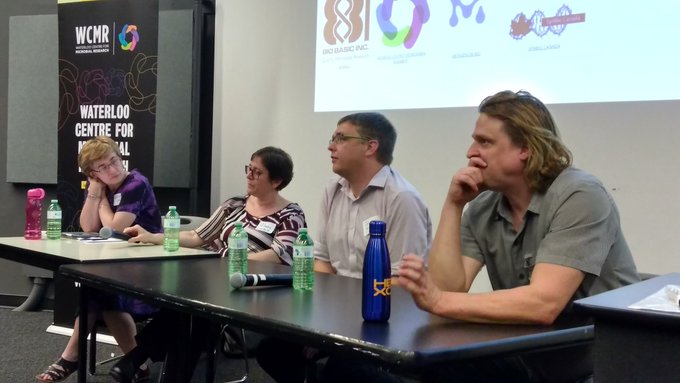
The education panel from SynBio 4.0, featuring (left to right) Kathleen Hill, Orly Weinberg, Jason Grove and Mads Kaern. Photo courtesy of Brian Ingalls.
Looking towards the future of synbio education in Canada, Wienberg gave a summary of current efforts at Concordia to construct synthetic biology focused curricula. These efforts in expanding synbio education are complementary to Concordia’s ongoing investment in its gene foundry. Similarly, Hill discussed efforts to launch synbio training programs at Western, and the various approaches to synbio education overall. Notably, these new programs at Western were initiated because of strong student support starting three years ago, in part thanks to the efforts of our Steering Committee member Samir Hamadache, and others involved in the student-driven Western Synthetic Biology Research Program. Grove compared and contrasted science and engineering, arguing that synthetic biologists are primarily engineers, due to the application focus of the field.
Post-panel discussion and questions highlighted several key needs:
The need for synbio-focused degree programs. There are currently no synbio-focused degree programs offered at any Canadian institution.
The strong need for funding of synbio education, lest Canadian research and companies fall behind international competitors due to a lack of skilled personnel.
The need for a clear definition of the skill sets to be taught in these programs, with input from industry as well as researchers. Defining the balance between fundamental skills and specific applications is a core challenge.
The need for investment and program development to scale with the growth of the Canadian biotech sector, so that graduates can transition efficiently to industry positions with a skillset matching industry demand.
The need for an education plan for the future. The biotech landscape is highly diverse and rapidly changing, it is difficult to find a one-size-fits-all solution in a single program. Planning is needed in order to offer an appropriate mixture of application specialties and graduate/undergraduate programs in a coordinated manner.
Research Talks Day 1
Conference organizers Valarie Ward, Brian Ingalls and Trevor Charles kicked off the first day of the research talks with opening remarks and introductions. Ned Budisa (University of Manitoba) gave the first keynote address, describing his groups efforts to expand the usable genetic code beyond the standard 20 amino acids. Working within this emerging subdiscipline of xenobiology, they are building the synthetic translational machinery necessary to re-code nature so unnatural or noncanonical amino acids can be included in proteins produced by engineered cells. This work has applications in protein production and bio-manufacturing, and Budisa specifically highlighted a project to produce wet-binding, bio-inspired adhesives. He noted his group is currently looking for motivated graduate students and postdocs.
The keynote was followed by a report from Bettina Hamelin. She highlighted Ontario Genomics current efforts to promote synthetic biology within the province and across the country, answering the dual questions; “Why synthetic biology and why now?”. Ontario Genomics envisions a three tiered plan for SynBio growth in Canada;
Establish technical capacity -- including the creation of genome foundries and the training of the necessary technical staff.
Create funding programs -- initially focusing on sandbox grants for disruptive projects to ‘feel’ out the tri-council, with the eventual goal of having flexible, phased-funding with a rolling-intake cycle.
Write a Canadian SynBio strategic plan -- following similar documents published by other countries like the U.S., U.K., Singapore, and Australia.
Ontario genomics is currently collaborating with other provincial and national organizations to create a SynBio Steering Committee to work towards the above goals. Hamelin concluded by saying:
“This is all about collaboration, we are too small a province - as a country we are small - collaboration is key because greatness happens together.”

Adam Radek Martinez delivering his (award-winning) research talk at SynBio 4.0. Photo courtesy of @Synbiosymp and WCMR.
Afternoon talks saw discussion about the harnessing of novel wild microorganisms and the engineering synthetic ones for bioproduction. Kenza Samlali (Shih Lab, Concordia University) presented work on the development of novel gene editing and biosensing on microfluidic chips. Kenza’s talk won the best graduate student presentation competition, which was sponsored by Carbon Patent Group. Other student talks featured many topics, including novel mitochondrial and genomic editing protocols, bioinformatic tools for engineering insect resistance and the use of engineered optogenetic tools for probing developmental pathways.
Adam Radek Martinez (Charles Lab, University of Waterloo) won best high-school/undergraduate talk for his work on the engineering of novel silver biosensors. The afternoon also featured a poster session, Sam Slattery (Western University) took home the poster prize for his work on a plasmid-based toolbox for Cas9-based genome editing.
Research Talks Day 2

The SynBio 4.0 poster session featured a diverse range of synbio research from Canadian institutions. Photo courtesy of @Synbiosymp and WCMR.
The second day of research talks began with a keynote from Wei Zhang (University of Guelph). His group has been working to make protein-protein interactions more engineerable, specifically focusing on the human ubiquitin signalling pathway. This work has a broad array of applications to human health, including the treatment of viral infections and better understanding of signalling pathways involved in cancer. The second day also saw many exciting talks from student and post-doctoral researchers, covering topics such as the development of mathematical and bioinformatic models, the engineering of bacterial-plant signalling for the coordination of nitrogen fixation, and the construction of modular, multi-host large-fragment cloning vectors.
The day concluded with an industry talk by Michael Pautler (Vineland, Platform Genetics), who discussed the current need for Canada-specific breeds of high-value horticultural crops. Currently Canadian growers use breeds that have been created specifically for European climates, and which underperform when grown here in Canada. While Vineland currently uses traditional breeding technologies (i.e. cross-breeding and mutagenesis) to address this problem, genetic engineering could play a role in helping Canadian horticulture to close this gap in the future. However, Pautler noted no GMO products are currently used in Canadian horticulture for two main reasons; 1) consumer acceptance for the technology is low because of current perceptions of genetic technologies, and 2) there is a high regulatory cost caused by the Canadian regulatory process. Pautler suggested that, in the current economic climate, if genetic engineering was successfully used to create an improved crop, it would be easier to get it approved and sold by randomly regenerating it through mutation then to proceed with the original GMO. This process is obviously inefficient. Paulter proposed addressing the regulatory barriers by standardizing and streamlining the regulatory process to make it more reasonable and efficient. He also suggested a permissive licensing of genome editing technologies would allow for their wider use. With respect public opinion, Pautler emphasized the importance in using the technology to develop crop traits that consumers care about and to clearly communicate benefits and limitations of the technology to consumers and other stakeholders.

Quick Chat: Professor Dr. Wei Zhang
We spoke with Dr. Wei Zhang, who is an Assistant Professor in the Department of Molecular and Cellular Biology at University of Guelph, working to engineer cell signaling via protein engineering.
Benjamin Scott - June 17, 2019

Dr. Wei Zhang, Assistant Professor University of Guelph
Dr. Wei Zhang is an Assistant Professor in the Department of Molecular and Cellular Biology at University of Guelph (www.thezhanglab.com). He conducted his PhD in the laboratory of Daniel Durocher in the Lunenfeld-Tanenbaum Research Institute of Mount Sinai Hospital and Department of Molecular Genetics at University of Toronto, where he identified new molecular mechanisms of telomere addition to DNA breaks and the spatial organization of DNA repair. For his postdoc studies with Drs. Sachdev Sidhu and Jason Moffat at the Donnelly Centre for Cellular and Biomolecular Research, Dr. Zhang developed combinatorial protein engineering approaches to manipulate human and viral enzymes controlling critical cell signal transduction cascades for innovative therapeutic strategies. He has received numerous awards, including the 2016 Mitacs Award for Outstanding Innovation, 2017 Cancer Research Society Scholarship for the Next Generation of Scientists, and the inaugural 2018 Donnelly Centre Research Excellence Award. To date, he has published 20 papers in high-impact journals and 3 pending patents. His lab is currently funded by Cancer Research Society, Rare Disease Foundation, NSERC, and CIHR.
How did your interest in synthetic biology first develop?
My interests in synthetic biology developed probably later than most people in the field, around the time when I was finishing my PhD and trying to figure out what I should do for postdoctoral studies. I was focusing on understanding the molecular mechanisms of telomere biology and DNA repair at that time and “synthetic biology” is really not something in my mind, until I started supervising an undergraduate student in the lab (Devin Trudeau, who later did his PhD with 2018 Nobel laureate Dr. Frances Arnold) whose project was synthesizing an artificial telomere. While the project went nowhere, it became clear to myself that my passion is not just exploring the mechanisms that drive cancer progression, rather to use that knowledge to ultimately develop effective drugs. Therefore, I changed my research focus from “understanding” to “modulating” cells signaling with the vision of bridging basic research and translational research by joining the laboratory of Dr. Sachdev Sidhu in the Donnelly Centre. Dr. Sidhu is an internationally recognized leader in protein engineering and phage-display technology. He spent a decade as a principal investigator in the Department of Protein Engineering at Genentech, Inc. He has led the development of phage-displayed synthetic peptide/protein/antibody libraries that have proven to be a rich source of valuable reagents for basic research and potential therapeutics for cancer and other diseases. During my postdoc tenure in the Sidhu lab (and later jointly supervised by Dr. Jason Moffat), I was able to combine the understanding of human cell metabolism to the generation of synthetic drug-like molecules that has potential for treatment of various human diseases. I expect this skill-set to serve as the foundation upon which I can explore my synthetic biology and protein engineering research program in University of Guelph.
About a year ago you started your lab at the University of Guelph. What advice can you impart to new PIs?
For new PIs, there will be many challenges other than the research itself. Here are what I learned from colleagues and mentors in my department and elsewhere. The three most important things are: People, Penny, and Paper. First of all: people. Surely you want to recruit the best to your lab, but that is not always easy and for different roles you need to look for different characteristics (e.g. technician vs graduate student). Here comes the second component of “people”: mentors. A good mentor will be extremely helpful on every aspects of a new PI’s life, including sharing experience in hiring. Please take advantage of every opportunity to broadcast your lab (invited talks, personal webpage, twitter, linkedin, etc.) to let the world know you are out there and recruiting. Second: penny. For a lab to be sustainable, getting competitive operating grant is essential. Start as soon as possible and apply as many as you can. Get support from your PhD and postdoc mentors and obtain suggestions/comments/feedback from people knowing your work and importantly, who are completely outside of your field. Grantsmanship is critical and that only comes to you after many rounds of revision based on suggestions from others. Do remember that sometimes it is good to be stubborn to stick to what you believe is the right way to write but definitely think from a reviewer’s perspective. Meanwhile, start engaging collaboration with other scientists and tap into funding opportunities that you can bring in convincing complementary expertise or become co-PIs and request for budget. Finally: paper. There is no need to further elaborate on this but I want to emphasize that try your best to avoid gap of publication. Instead to show your independence, which is important, it is ok to continue work with previous mentors and collaborators to have a continuous track record of publishing.
Are there specific resources needed to strengthen synthetic biology in Canada? What would make Canada a better place for the field?
Synthetic biology in Canada is booming, thanks to not-for-profit organizations like SynBio Canada, funding agencies like Ontario Genomics, and many other small and big firms willing to invest and nurture this emerging genre. I think Canada has a huge talent pool for the broad field of synthetic biology. In my opinion the value of synthetic biology in translational research is indeed recognized in Canadian public and private sectors. However, to make Canada a better place for this field, one has to realize the importance of conducting basic research for the benefit of synthetic biology, and vice versa. I find that in most cases it is presumable that for synthetic biology research you need/should get match from industry sources and there is a bias about what kind of synthetic biology research we conduct in Canada. There should be more operating grant funding opportunities from government agencies supporting basic research, such as Canadian Institutes of Health Research (CIHR) and Natural Sciences and Engineering Research Council of Canada (NSERC). How about establish an Institute for Synthetic Biology in CIHR? Similarly, “Synthetic Biology” could be a separate Evaluation Group in NSERC Discovery Grant program.
You’ve used phage display technology extensively for your protein engineering work. What makes this technique so useful?
Half of the 2018 Nobel Prize in Chemistry was awarded to Dr. George P. Smith, who invented phage display, and to Sir Gregory P. Winter, who used phage display to evaluate peptide and antibodies for therapeutic purposes. Needless to say, phage display is powerful and essential for protein engineering. It is very easy to learn and perform the experiments, and quite reliable and efficient in selecting for binders from a library of billions of variants. Other competitive advantages include: 1. Fast and cost-effective production. The whole process takes about 2 weeks and only purified proteins, phage, and E. coli are being used. 2. Highly amenable to rational optimization. The affinity and specificity of selected binders can be further improved. 3. Identification of competitive and allosteric regulation on protein surfaces small molecules cannot reach.
What are some up-and-coming synbio techniques or applications you’re excited about?
I have to give it up to CRISPR. We all witnessed how this technology revolutionized biological research in the past 5 years and it will continue to do so, particularly pertaining to synthetic biology. My lab is also interested in further improving the efficiency and accuracy of CRISPR in genome editing by manipulating DNA damage and repair. I do want to note the importance of ethics in implementing this technology in clinical research, as we heard from Dr. Jiankui He who shocked the world by revealing his controversial human embryo experimentation.
We’re trying something new with our “SynBio Grand Challenges” leader board game. You get 5 points to either add to or subtract from each of these Challenges. -3 points means the challenge is removed, and you can replace it with your own idea! Be ruthless!
Some possible examples: You give +1 point to each, or you give +2 points to two of them and -1 point from one.
The SynBio Grand Challenges Game
- Specific and tunable human gene editing +2, Score = 7
- Carbon neutral chemicals & fuels +2, Score = 4
- “Smart” therapeutics that sense and respond +0, Score = 4
- Multi-host nitrogen-fixing microbes +0, Score = 2
- Microbes for bioremediation +0, Score = 2
- A genetic code that uses new amino acids -1, Current Score = -2

Canada SynBio 2019 (Part 2)
In part 2 of our summary of Ontario Genomics’ Canada SynBio 2019 conference, we discuss the investor showcase, the pitch competition, the keynote from Ginkgo’s Christina Agapakis as well as highlights from the final panels and the second day, including an update on Canada’s first genome foundry at Concordia University.
NATHAN BRANIFF - April 4, 2019
In part 2 of our summary of Ontario Genomics’ Canada SynBio 2019 conference, we discuss the investor showcase, the pitch competition, the keynote from Ginkgo’s Christina Agapakis as well as highlights from the final panels and the second day, including an update on Canada’s first genome foundry at Concordia University.
VC Investor Showcase
“Be bold, you want to be the leading company, not just in Canada, but worldwide.”
The afternoon session began with the investor showcase, where venture capitalists from the US and Canada gave insight into the biotech start-up ecosystem. The panel featured Sean O’Sullivan of SOSV, Ganesh Kishore of Spruce Capital Partners, Élizabeth Douville of AmorChem and Collin Kelleher and was moderated by Mary Dimou of Canopy Rivers. The panel emphasized the diverse range of companies that the investors have funded, and the many strategic paths to a profitable startup. O’Sullivan noted that “We’ve seen great companies coming out of Canada and we’d love to see more.” Douville, who represents Quebec-based biotech investment fund AmorChem, encouraged biotech researchers to reach out “If you are an academic investigator with a disruptive technology you should come talk to us.” AmorChem focuses on building companies out of academic research, investing early in promising technologies.

FREDsense won first place in the pitch competition, with a cash prize of $25000 and $5000 worth of supplies from IDT. (Photo by Nathan Braniff)
Pitch Competition: Accelerating Startups by Design
The VC investor panel also served as the judges for the Accelerating Startups by Design pitch competition. A new addition to this year's conference, the competition highlighted six synthetic biology startups who presented for both cash prizes, and laboratory resources courtesy of IDT. Canadian startup FREDsense won first place with its synthetically engineering biosensors for water contamination detection. Quebec-based startup, Tatum bioscience, took second place for its engineering of a reprogrammable CRISPR-based targeting of antibiotic-resistant gut pathogens.
The other competitors included Genecis Bioindustries, Creative Protein Solutions, Spindle Biotech and Metaphage Bioceuticals. Genecis Bioindustries has engineered bioprocesses to produce a bio-plastic precursors, polyhydroxyalkanoates (PHA’s), from organic waste. Creative Protein Solutions has created a diagnostic device using an engineered biosensor for rapid, onsite monitoring of diseases in cattle. Spindle Biotech is building novel DNA synthesis technology, using specialized enzymes and microfluidics to improve performance and decrease costs. Metaphage Bioceuticals is using DNA mini-strings to engineer a novel trans-gene delivery mechanism for gene therapy, this will ideally increase treatment reliability and decrease the time needed for regulatory approval.

University of Guelph iGEM Team accepting first place for the poster competition. (Photo by Nathan Braniff)
In addition to the pitch competition, this year’s conference also featured a student poster competition. The University of Guelph iGEM team took the top spot, with their work to engineer enzymes to degrade “beer stone”, which is calcium oxalate that builds up in the beer brewing process.
Keynote - Christina Agapakis, Ginkgo Bioworks
Christina Agapakis, Creative Director at Gingko Bioworks gave an exciting keynote talk on the companies ongoing work to make biology easier to engineer. Ginkgo has been a pioneer in scaling up bio-engineering, with 50 Mbp of DNA synthesized each month, and individual projects having as many as 20000 distinct enzymes synthesized and tested. Agapakis noted Ginkgo’s strong emphasis on collaboration between their ‘Foundry’, which performs the automated biological lab work, and their ‘Codebase’, containing the antotations and theoretical knowledge needed to guide and expedite new biological designs. While the foundry uses state-of-the-art automation and parallelization to synthesize and test new genetic designs, the codebase contains data on the functions of proteins and specific DNA sequences which allows for rapid sharing of knowledge between projects. This harmonious interplay has led to a bioengineering version of Moore’s law, known at Ginkgo as “Knight’s Law”, named for Ginkgo and SynBio founder Tom Knight. Knight’s law suggests engineering new genetic designs will undergo an exponential decrease in cost in the near future, heralding an important role for synthetic biology in many industries over the coming decades.

“To create a new technology, you are not just engineering the technical part, you’re [also] engineering a social part."
Christina Agapakis, Ginko Bioworks
Agapakis also discussed Ginkgo approaches to public outreach and its strategy for engaging with the public regarding genetically modified organisms (GMO’s). She suggested the GMO debate is a major hurdle for industrial synthetic biology, and the debate is complex touching on ethics, intellectual property, public policy, philosophy and the very definition of ‘natural’.
As indicated by Ginkgo CEO Jason Kelly’s New York Times Op-Ed, Ginkgo has taken the strategy of fully embracing the label GMO, indicating to consumers that GMO’s are not only safe, but something valuable and to be proud of. In an effort to rebrand and take ownership of the term ‘GMO’, the company has highlighted the unique social value of genetic engineering in projects like ‘Resurrecting the Sublime’. In ‘Resurrecting the Sublime’, Ginkgo used its genetic engineering and bioinformatic infrastructure to reconstruct and synthesize odours of extinct plants, enabling them to create scents that without genetic engineering would have been lost forever. Agapakis suggested outreach projects like this, combined with a policy of transparency, will hopefully prompt people to reconsider the social value of genetic engineering.
Making Biology Easier to Engineer Panel
The final panel of the day focused on general aspect of engineering biology. Panelist Vince Martin of Concordia University discussed the recent opening of Canada's first genome foundry. Martin announced it was already expanding, after only a year or so of operation, with plans to enable engineering of mammalian cell lines in the near future. He also stated that since foundries are becoming so popular, the team at Concordia has been fielding questions from other groups around the world. Because of all this interest, half-jokingly he said that his group had suddenly become experts in running a synbio foundry.

“[We need to] pay attention to the opportunity cost of not exploring a promising field.”
Vardit Ravitsky, Université de Montréal
While the foundry was originally intended primarily for research and training, it was on track to transition to a more accessible service model due to popular demand. Martin suggest the foundry would increase ‘the number of shots on goal’ for SynBio projects in Canada, by allowing for faster and cheaper DNA synthesis. He also discussed the Concordia Foundries participation in the Global Biofoundary Meeting 2019, which will emphasize standardization and inter-foundry collaboration across the many foundries in other countries. Those interested in the Concordia Foundries services should reach out to its administrative team.
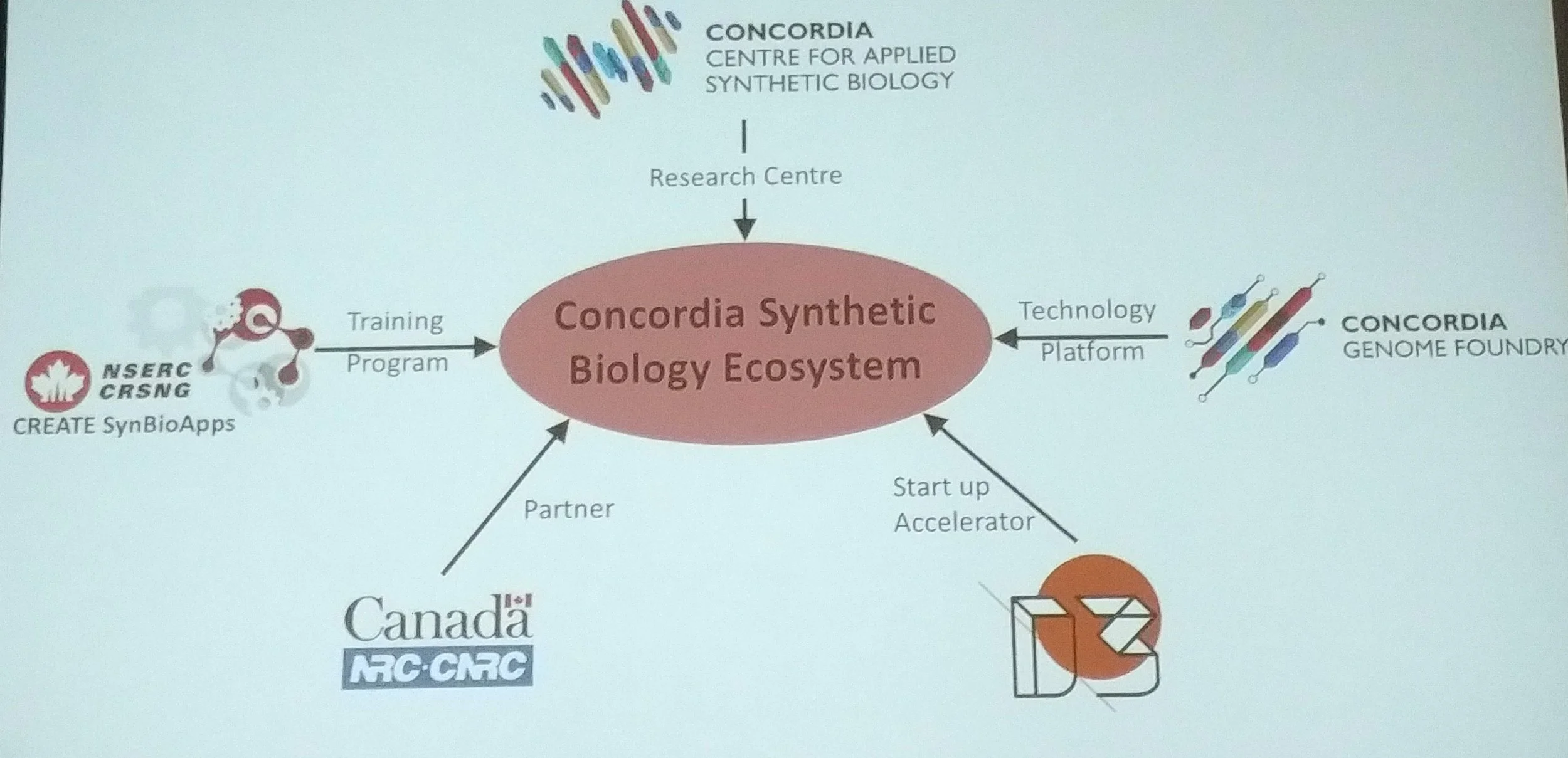
Vincent Martin presents on the exciting synbio ecosystem being developed at Concordia University. (Photo by Benjamin Scott)
Vardit Ravitsky (Université de Montréal) discussed the social and political aspects of more widespread engineering of biology. She emphasized that the ethical debate around genetic engineering often neglects the duty to share the benefits of new technologies. She said their is also an ethical obligation to ask ‘why yes?’. There exists a real risk that a useful technology that can help millions of people will not be developed because of fear. She suggested that a lack of proportional regulation, that balances positive and negative risks, may hold Canada back.
Ravitsky also emphasized the duty of Canadian scientists in public outreach. She urged scientists to speak to journalists often, stating that a fear of misquotation or of speaking outside your expertise is not a realistic excuse; it is a “very real part of your job.” She concluded emphasizing the importance of public outreach, and that realistic, grounded communication about the technology is a good safeguard against sensationalism and fear mongering, and the potential regulatory backlash caused by either.
Up next is a quick rundown of workshops on Day 2!

Canada SynBio 2019 (Part 1)
Earlier this month, Ontario Genomics hosted the second annual Canada SynBio meeting in Toronto. The meeting brought together members of the Canadian and international synthetic biology community for a two day discussion of research, business and policy topics related to the rapidly developing field. The event expanded significantly upon last year’s successful conference, with a variety of panel discussions, and a pitch competition from start ups.
Nathan Braniff - March 23, 2019
Earlier this month, Ontario Genomics hosted the second annual Canada SynBio meeting in Toronto. The meeting brought together members of the Canadian and international synthetic biology community for a two day discussion of research, business and policy topics related to the rapidly developing field. The event expanded significantly upon last year’s successful conference (summarized here), with a variety of panel discussions, and a pitch competition from start ups.
Several members of the SynBio Canada Steering Committee were able to attend. In this article, we summarize some of the discussions and presentations from the first day, highlighting some of the fantastic synbio research and companies in Canada and abroad.
Keynote - George Church, Harvard University
The first day began with a keynote talk by Professor George Church of Harvard University. He summarized the many recent advances in multiplex genome engineering that his research group has pioneered, including the editing of mammalian cells for virus resistance and in vivo lineage tracking. He also outlined the goals for Genome Project Write (GPW), the multi-national collaborative follow-up to the original Human Genome Project (HPG). The original HPG successfully sequenced a human genome in 2003, which led to rapid advances in efficiency and cost for DNA sequencing over the following decades. The new GPW, led by those like George Church, will attempt to synthetize a synthetic human genome (in cell lines) over the coming years. The GPW has several contributing members from Canadian institutions. Professor Church discussed the range of potential applications of DNA synthesis technology developed as part of GPW, including developing cryo-stable organs for transplant, investigating cancer and senescence resistance in model organisms as well as engineering viral resistance.
When asked about the potential for misuse of these emerging technologies, Church emphasized the importance for surveillance and biocontainment, as opposed to moratoriums. He also pointed out that applications like human germline editing are not only ethically but also technically difficult, and the technology has many more immediate applications, like making organs more accessible for transplant. These immediate goals have fewer ethical concerns and can be accomplished in the short term with widely distributed benefits to society.

“We have banned the word impossible in my lab.”
Dr. George Church, Harvard University
Human Health and Engineering Biology Panel

Dr. Laura Prochazka (postdoc in the Zandstra lab, University of Toronto/UBC) presents work to engineer stem cells using synthetic biology. (Photo by Benjamin Scott)
The Human Health and Engineering Biology Panel featured discussion of novel health related engineering effort being developed by researchers in Canada. Laura Prochazka (University of Toronto) gave an overview of ongoing efforts to engineer more safe and efficient stem cell therapies using synthetic biology to guide cell specialization. Keith Pardee (University of Toronto), discussed his labs ongoing development of paper-based cell-free biosensors, which have been used to detect viruses like Zika and Ebola. He also outlined his work using synthetic biology to engineer biosensors and on-demand biomanufacturing to address global health and food security. Ubaka Ogbogu (University of Alberta) emphasized the need to pursue these novel therapeutic technologies guided by small “r” regulation, which focuses on proportional policies rather than outright moratoriums. Ogbogu also suggested the need for the community to plan synthetic biology ventures and outreach wisely, focusing on open communication and stewardship on behalf of those who cannot advocate concerns for themselves, as well as the importance of sharing technology and expertise with developing regions where some of the genetic resources have originated.
Synbio and Industrial Biotechnology Panel
The SynBio and Industrial Biotechnology panel saw discussion of the role of synthetic biology in manufacturing commercial products. Krishna Mahadevan (University of Toronto) discussed his group's ongoing work engineering bioprocess pipelines from end-to-end, pointing out Canada’s strength in raw materials. Pratish Gawand gave examples of how his company Ardra Bio is harnessing synthetic biology for the manufacturing of natural products for the cosmetic industry.
Sandy Marshall of Bioindustrial Innovation Canada warned that the petrochemical industry has a big head start on biology-based manufacturing with respect to bulk consumer ingredients and that it is very hard to convert biomass into bulk products at a competitive scale. Marshall suggested that high-value, more complex speciality products are a promising niche for synthetic biology-based approaches to add value.

“The petro-chemical industry has a 160 year headstart on you.”
Sandy Marshal, Executive Director of Bioindustrial Innovation Canada (BIC)
Cannabis Panel
The Cannabis panel featured discussion of the potential role of synthetic biology in Canada’s emerging cannabis industry. Hyansynth CEO Kevin Chen discussed the need for a scale up in production of therapeutic cannabinoids in order to meet growing demand, highlighting the potential role of pathway engineering via synthetic biology. Hyasynth is also currently seeking to fill positions for CFO and Head of Research. Jess Leber of Ginkgo Bioworks discussed their collaboration with Canadian company Cronos Group for the production of cannabinoids, harnessing Ginkgo’s expertise in strain engineering.
Leber pointed out that while Canadian marijuana growers may have an advantage in the short term due to differences in regulation, in the long run therapeutic and recreational production will likely rely on fermentation. Engineered strains can be used for production anywhere and can be tuned for a range of production goals. The general consensus of the panel pointed to a strong role for pathway engineering in cannabinoid production in the near future.
Agriculture Panel

The agriculture panel discusses recent advances in gene editing. From left to right: Ian Affleck (CropLife Canada), Emily Marden (UBC), Michael Lohuis (Semex), Clara Alarcon (Corteva Agriscience). (Photo by Benjamin Scott)
The agricultural panel focused on the regulatory and social challenges faced by introducing genetically engineered organisms into food production. Clara Alarcon, Director of Molecular Engineering at Corteva Agriscience, noted regulatory obstacles, like decisions by European courts to group editing technologies like CRISPR in the same category as other GMO’s, are a major barrier to making use of new technologies. Alarcon pointed out that while CRISPR can precisely modify a single target, mutagenesis which introduces many more genetic alterations, is treated with much less scrutiny. Inconsistent and restrictive regulation are especially problematic at a time when climate change may threaten food security, and tools will be needed to adapt crops to variable growing conditions. Michael Lohuis, VP Genetics R&D at Semex, also indicated that fear among consumers is an issue the industry has still not effectively dealt with. This fear has created an environment where regulators and also competitors are each waiting for their counterparts to make the next move. There is a fear of ‘tarnishing the reputation of [something like] milk… nature's perfect food’, he said.
Several panel participants noted the difficulty in changing public perception, especially as the value of improved farming practices are often lost on people living in urban areas, far from the farm. Small companies with limited PR budgets have a difficult time changing public opinion. Lohuis noted Semex has focused on transparency as well as engineering traits that consumers see the clear social benefit of, such as animal welfare, not just what's best for the company's bottom line.
Emily Marden, of the Faculty of Law at UBC, noted that, in contrast to the previously discussed regulation, laws governing the ownership and benefit sharing for digital sequence information, which may be sourced from organisms in the developing world, is still lacking. She noted the ethical concerns going forward, as international regulation has not clarified exactly what responsibility genetic engineers using sequence information may owe to the originating regions from which they are taken. Marden suggested this benefit sharing does not necessarily need to be monetary, and could be provided through educational exchange or through job creation. She warned that it may be better for the industry to proactively address these issues before regulation makes them mandatory, as this establishes the positive uses of the technology and may convince the public of their value.

My Experience at SynBioBeta 2018: The Global Synthetic Biology Summit
SynBioBeta is a synthetic biology conference that brings together business entrepreneurs and scientists from around the world. In 2018 it was held from Oct 1st -Oct 3rd at the Mission Bay Conference Center, San Francisco. I had the pleasure of attending this conference and it was a phenomenal experience!
Amy Chen - February 10, 2019

Evening reception at SynBio Beta. The ground floor of the conference hall was filled with people. It was a great night of mingling with other Synthetic Biology enthusiasts.
SynBioBeta is a synthetic biology conference that brings together business entrepreneurs and scientists from around the world. In 2018 it was held from Oct 1st -Oct 3rd at the Mission Bay Conference Center, San Francisco. I had the pleasure of attending this conference and it was a phenomenal experience!
The first day started off with a keynote panel about the revolution in materials and a panel on how we can educate, incubate, and accelerate the next generation of synthetic biologists who will be fueling the bioeconomy. These discussions led to the SynBioBeta Awards in which leaders in public engagement and synthetic biology were recognized for their spirit, passion, and impact within the community. Dr. Christina Agapakis from Ginkgo Bioworks was recognized for her excellence in public engagement. Recognized for their excellence in leadership in Synthetic Biology were Bryan Johnson and Jeffrey Klunzinger, the co-founders of the OS Fund, a venture that invests startups that are working on breakthrough discoveries in genomics, synthetic biology, artificial intelligence, precision automation, and new materials development. Dr. Richard Kitney and Dr. Paul Fremont from SynbiCITE, UK’s national Innovation and Knowledge Centre that promotes the adoption and use of synthetic biology by industry. It was extremely inspiring to learn about these leaders who are trailblazing the way for the advancement of Synthetic Biology.
My favourite part of the night was the fireside chat featuring Steve Wozniak and George Church. This was an epic meeting of two giants of technology who were both powerhouses behind innovation that has created so much impact in the world. It was very interesting to see how two people who were different in terms of beliefs, background, and experience came together to find common ground for discussion and connect through discovering similarities.
Fireside chat: DIY bio: The home brew computer club featuring with Mr. Steve Wozniak, Technology Entrepreneur and Dr. George Church, Harvard and MIT
The second and third day were filled with numerous keynote fireside chats, panel discussions, breakout sessions, and training workshops. Some of the highlights from those two days included a keynote fireside chat called “Neuroscience & Synthetic Biology: the Neobiological Revolution”. This workshop was particularly interesting because it presented rising synthetic biology technologies that can potentially treat neurological diseases and even enhance cognitive abilities.
During the breakout sessions, I really enjoyed the session on emerging women leaders in synthetic biology. I was elated to see a gender-balanced audience in the room who were interested in addressing the persisting problem of under-representation of women in science and engineering careers. The panelists explored questions such as how do we identify/create/amplify/become champions to encourage more women to pursue leadership within Synthetic Biology and STEM, in general?
The lightning talks by companies like Zbiotics, DNA Script, Dupont, Siolta Therapeutics, Indie Bio, and Novozymes offered a panoramic overview of the cutting-edge landscape for synthetic biology. There were many more interesting sessions throughout the second and third day. I enjoyed all of these sessions as they led me to think about issues that I have never considered and open my eyes to the breadth of synthetic biology research happening in the world.
After the three-day conference, I was able to reflect on this fantastic experience. As an undergraduate student, I have attended many academic conferences and symposiums. However, this past October was my first time attending a conference like SynBioBeta. This conference was a unique and unforgettable experience as it widened my scope of the impact and potential of synthetic biology. This event was different from academic conferences because research results and data were not the only focus of the conference. Instead of the usual poster and oral presentations, the conference was organized in a way that facilitated knowledge translation in a different sense than just research. The conference presented advances within the industry in addition to interesting research findings within academia. The conference consisted of discussions and fireside chats, which provided interesting insights into the future projection for the industry, education, and social impacts. The engaging environment inspired scientists, entrepreneurs, academics, investors, policymakers, and pioneers to use synthetic biology to build a better future. Walking into the conference, I was a bit anxious because I had no idea what to expect. However, after the conference, I walked away feeling inspired and with a renewed sense of purpose.
There were three main takeaways for me after attending SynBioBeta.
Firstly, I was blown away by the wide range of topics presented at the conference and learned so much within the few days I was at SynBioBeta. The talks covered various intriguing topics such as Bio Meets Tech, industrial revolution 2.0, the bioeconomy culture, biopharma and health, energy and environment, and food and agriculture. The exposure to numerous diverse synthetic biology ventures within a wide range of sectors illustrated the revolutionary advances happening within the synthetic biology industry. As a past iGEM participant, it was extremely motivational to see how people have transformed their research and proof-of-concept projects into successful companies that are solving real-world problems in the world today. Not only is synthetic biology changing the field of healthcare and pharmaceuticals, but it is also making significant contributions for food, biomaterials and consumer goods. There were even out-of-this-world applications of synthetic biology that are looking into engineering biology for bio-fabrication in extraterrestrial conditions.

“I Love GMOs” display from Ginkgo Bioworks. Currently, there is still much skepticism and stigma around synthetic biology. However, I hope that through the continuous efforts of our synthetic biology community that we can openly say that we love GMOs! I think that this movement started by Ginkgo is truly inspirational and is a great trailblazer for making synthetic biology more understandable and approachable to everyone.
Secondly, the conference pushed me to be comfortable with feeling uncomfortable. The experience challenged me to make genuine and meaningful connections with other conference attendees by stepping out of my comfort zone. As one of the few undergraduate students who attended the conference, I felt a bit out of place at first. However, after talking to a few people who were now decades ahead into their careers, I realized that they started off very much in the same place I did. I was very excited to hear about their experiences and learn from their insights. Although it may seem intimidating to approach people at first, I found that people were generally very inviting and eager to share their experiences with you. For example, there were many company booths at the conference. Going around from booth to booth, I asked the representatives about their experience working in this industry and how they got to where they are today. These conversations showed me that even as undergraduate students, we have the knowledge to apply for internships within these companies. Many companies eagerly hire undergraduate students as interns and support them in their integration into various project teams. Therefore, if you are a student attendee at SynBioBeta, I would encourage you to be uncomfortable with being outside your comfort zone and to approach people who are working in sectors you are unfamiliar with.
Thirdly, this conference has allowed me to see the bigger picture for the future of synthetic biology. Oftentimes, as undergraduate students, we see synthetic biology through an academic lens. If we are doing a summer research project, many of us are focused on the scientific techniques and are less often concerned with social trends that will impact our research. However, the many panels that addressed the impact of trends in science investment, science literacy, consumer preference, biosecurity, and bio-strategies companies shed light on the importance of these factors in propelling a field.
The impact that these factors can have are not limited to the industry but are relevant to academics as well. For example, how do we teach science literacy to investors to increase their confidence in their investment? How does consumer preference affect the success of synthetic biology companies? How is biosecurity changing and what are the effects of these legislative changes? What constitutes a successful bio-strategy for companies? Realization of the impacts of these concerns has provided me with a holistic evaluation of the gap that needs to be filled in order for synthetic biology to progress. Having seen so many people who were enthusiastic about synthetic biology at SynBioBeta, I am very excited to see the amazing new advances to come at next year’s conference!
Special thanks to John Cumbers for inviting me to attend and present my iGEM Project “Astroplastic: From Colon to Colony” as part of the focus breakout session: Space applications of synthetic biology! This was a truly incredible experience!

What’s in a Name? Defining and Relating Synthetic Biology to Biomedical Engineering
Biomedical engineering (BME) and synthetic biology are in some ways very similar, but also distinct fields. This relationship makes defining and separating the two quite difficult. In addition, as interdisciplinary fields, multiple definitions may apply to each.
Brendan Grue - January 7, 2019
Juliet pleaded: “What’s in a name? That which we call a rose by any other word would smell as sweet”, when referring to the irrelevance of Romeo’s rival family name of Montague in William Shakespeare’s famous play. Perhaps this draws analogy to the possible arbitrariness of naming the fields of synthetic biology as well as biomedical engineering. Would synthetic biology still hold similar associated sociological and scientific cogitations if called artificial or manufactured biology?
Like myself, you may have heard the classic physico-centric phrase from your high school physics teacher that all biology is chemistry, and all chemistry is physics. In a way, this may be true, but why then are these broad fields defined separately? Why aren’t all science courses listed under the department of physics or math? Why is it important to have a clear definition of these fields in the first place? Is synthetic biology simply just the next buzzword to induce new excitement in the already existing field of biomedical engineering?

Image credit: Brendan Grue
Biomedical engineering (BME) and synthetic biology are in some ways very similar, but also distinct fields. This relationship makes defining and separating the two quite difficult. As interdisciplinary fields, multiple definitions may apply to each. If we are to ask Wikipedia, BME is defined as: “-the application of engineering principles and design concepts to medicine and biology for healthcare purposes”. While synthetic biology is defined as: “an interdisciplinary branch of biology and engineering – [combining many] disciplines to build artificial biological systems for research, engineering and medical applications”.
Perhaps these fields are not completely mutually exclusive as some may think. Were these fields separated and labelled in an attempt to seem revolutionary towards funding agencies? From these definitions it is unclear whether these two fields are even separate, or rather just subdisciplines of one another. Some believe synthetic biology is sometimes wrongfully accused as being simply genetic engineering in disguise (not to trivialize the later), when it may not be engineering at all, instead a modification or rearrangement of existing biological systems. In genetic engineering, it is thought that the function of the transferred gene is still that of what occurs in nature, think human insulin production in bacteria, whereas synthetic biology creates end products with original or novel functions.
Through defining synthetic biology as a technological field apart from biochemistry and molecular biology and particularly systems biology, we change the way we perceive and treat this area of biology as a society from a natural understanding perspective to a goods, means, and ends framework. This perception may peak the interest in the public and those responsible for the funding of new areas of research, since synthetic biology is more interested in the application of biology to create useful systems capable of fulfilling needs, or wants, in a changing society. In addition to funding and resource allocation, defining a new area of science as distinct from existing areas may contribute further towards proper intellectual knowledge transfer in addition to multi-sector translation.
Coming back to the relationship between synthetic biology and BME, to the layperson, they may seem to be analogous terms. To the respective research communities however, their borders are more clear. Traditionally dominated by molecular biologists, synthetic biology aims largely to construct biological systems that do not exist in nature, utilizing genetic manipulation. Biomedical engineers on the other hand are thought of as engineers first, biologists second, usually possessing native tongue in the maths and physics as opposed to cellular biology and medicine. BME is largely focused upon providing inorganic solutions to healthcare needs, while synthetic biology approaches these healthcare problems, as well as problems from various other sectors, in an organic way often through the use of engineered biomolecules or living cells. In terms of applications, the engineers are thought to have an end commercial product in mind whereas this may not be the goal of the synthetic biologist, who often use synthetic biology as a tool to better understand natural systems.
A bridge between synthetic biology and BME, along with other related fields for that matter, is required to allow those working on individual components of a larger project to take the other parts for granted, otherwise known as decoupling. In this way, a single area or research group isn’t limited to its own technical expertise when deciding what it can create. Instead, those involved in the design of future synthetic biological systems are not bound to what they are themselves experts in, rather higher-level systems can be created through the application of many different experts each bringing forward single components, referred to by some as abstraction.
This ideology may however be somewhat simplistic and inherently ignorant of true biological systems, stemming from its inorganic mechanical framework and underappreciation for complex biological interactions, context dependence of parts, and responses to the environment. It may be neat to think of designed biological systems or organisms in a modular way, but final, often unpredicted, interactions between implemented parts can foil expected design outcomes, requiring ongoing redesign.
It is difficult to draw the line on what should and should not be included in both the fields of BME and synthetic biology. It may seem that their definition as a construct may be bureaucratic in nature. However, as was mentioned previously, there is utility in seeking distinct definitions for these subdisciplines, particularly regarding regulatory classification in relation to ethics, safety, security, funding, and intellectual property management. Examples of these issues relating to regulatory classification may come from the differences between classifying medical devices vs. engineered cells/biomolecules regarding health treatments, as well as the laws surrounding the patenting of medical devices compared to engineered genetic information and living organisms.
Even though there may be some utility in keeping BME and synthetic biology as separate fields, melting of their borders should be facilitated when speaking towards future educational programs and technological innovation and collaboration. Synthetic biology may just be the next natural extension of science, mirroring that of which was done with chemistry in the 19th century to form the field of synthetic chemistry and chemical engineering which contributed to early drug synthesis and the production of consumer goods. Synthetic biology may be a product of our heightened knowledge of analytic biology, like the earlier analytic to synthetic shift in chemistry. As was seen with the explosion of synthetic chemistry, the resultant economic and social impact of synthetic biology is not to be undersold. The impact of synthetic biology, and its combination with biomedical engineering techniques and knowledge, translates far beyond the health field, reaching energy, environment, agricultural, and even computing and data management sectors.

International Symposium on Synthetic Biology in Toulouse, France (Part 2)
The second day of the EUSynBioS Symposium this past October was jam-packed with presentations from senior scientists and students from all over, including Canada. Here, I summarize some of the sessions I attended.
Samir Hamadache - December 25, 2018
The second day of the EUSynBioS Symposium this past October was jam-packed with presentations from senior scientists and students from all over, including Canada. Here, I summarize some of the sessions I attended. (read about Day 1 here)
SynBio Society Consortium: an international commitment to collaboration
With the international expansion of synthetic biology research, there is an opportunity for synthetic biology societies to learn from and collaborate with one another. Over lunch on the second day, we discussed some first steps for launching an international SynBio Society Consortium and potential opportunities for collaboration. Following the consortium, we produced a joint statement to assert a commitment to collaboration:
SynBioS - towards stronger international connections in synthetic biology
Accompanying the establishment of synthetic biology as a discipline, the past five years have seen many local, national, and supranational synthetic biology groups founded around the globe. United in the aims of promoting synthetic biology research as well as professional and policy development, the associations can benefit substantially from forging and maintaining strong horizontal connections.
On October 23rd, representatives from six national and supranational synthetic biology associations - EUSynBioS (Europe), SynBio UK (United Kingdom), GASB (Germany), SynBio Australasia (Oceania), SynBio Canada (Canada), and EBRC SPA (United States of America) came together at the 2018 EUSynBioS Symposium Toulouse to set the foundation for a new international collaborative effort, the SynBioS Consortium. The representatives introduced their history, activities, and future plans through short presentations and discussed various topics of mutual interest, such as funding, social media, and science policy.
Concluding the workshop, the representatives confirmed their interest in continuing discussions as part of the future SynBioS Consortium, which will include regular online meetings focused on exchanging advice, coordinating initiatives, and reviewing progress.
We are looking forward to advancing synthetic biology together and encourage other national synthetic biology associations to join our endeavour.
~ EUSynBioS, SynBio UK, GASB, SynBio Australasia, SynBio Canada, EBRC SPA
Standards in synbio, a new carbon-source for E. coli, and virtual organisms
Dr. Manuel Porcar (University of Valencia, Spain) kicked things off Tuesday morning with an overview of the opportunities and challenges surrounding standardization in synthetic biology. While universal synbio “parts” would be ideal to make designing gene circuits easier, Dr. Porcar highlighted that living systems are so diverse—even within the same species—that standardized synbio parts may not turn out to be as convenient as we’d like. In fact, most parts used by iGEM teams are new to the competition’s registry. Dr. Porcar pointed out that, so long as evolution is in the picture, standardizing parts for use in natural environments is futile, since the parts will naturally change over time. On the other hand, he suggests that parts could be standardized for specific chassis (host organisms) used in the lab for particular functions. For example, D. radiodurans is the go-to microbe for work involving strong radiation. He also discussed BioRoboost, a new project funded by the EU with 27 partners from Europe, North America, and Asia, aimed at finding an international consensus on defining biological standards.
Rational design and directed evolution are two techniques that synthetic biologists use to generate new biological systems: the former involves modifying or recombining biological parts from nature, and the latter involves randomly mutating genes and selecting for desired traits. From Génomique Métabolique in France, Dr. Volker Doring presented work directing the evolution of E. coli strains to produce amino acids from formic acid. Formic acid is a single-carbon compound that can be made from CO2, and so this is a valuable opportunity for biofuels and environmental remediation. In the same issue of ACS Synthetic Biology, Dr. Doring’s team also published a rational design approach to obtain the same outcome, showing that new carbon-uptake systems can be produced using both directed evolution and rational design.
Rationally designing metabolic pathways is a daunting task that Toulouse-based start-up company iMEAN is making easier using virtual organisms. To close the morning session, Dr. Lucas Marmiesse, Co-Founder and CTO, presented their company, which specializes in in-silico models analysis. Using their extensive database of gene-regulatory and metabolic networks, they create millions of “virtual organisms” that can produce a client’s desired metabolic product. Using an artificial intelligence algorithm, they identify the best design to recommend for experimental validation. iMEAN aims to simplify the design phase of large-scale projects for synthetic biology companies and researchers.
Noisy genes, metabolic engineering, and building a bioeconomy
When a gene is expressed into a protein by a cell, there are several steps that depend on random events taking place, like the right proteins finding the start of the gene on a DNA molecule. These random events result in fluctuations in the rate of the protein being produced, and this variation is known as gene expression noise.
Dr. Fabien Duveau, at Université de Paris Diderot in France, has been studying the effect of expression noise on the evolutionary fitness of cells sharing the same environments. Dr. Duveau’s research team has developed a library of yeast strains with unique mutations to the promoter of the TDH3 gene, a gene that is known to affect fitness depending on its noise level. The different mutations result in different levels of noise in the TDH3 gene, as well as different average levels of expression. Then, they compared the growth rates of these different strains. They found that when the average expression level was close to optimal for survival fitness, more noise resulted in slower growth; but when the average expression is far from the optimum, noisier expression was advantageous. In other words, when the expression of an important gene like TDH3 is much higher or lower than needed, more noise means that more cells will express the gene at levels closer to optimal, helping them grow faster.
Dr. Max Mundt, at the Max Planck Institute for Terrestrial Microbiology in Germany, is also studying gene expression noise and has developed an effective tool for precisely tuning the noise and average expression level of a gene. Being able to control expression noise is important in order to study its role in natural biology or to reduce uncertainty in synthetic systems. Their system works by allowing the experimenter to control two steps in gene expression: transcription of the mRNA intermediate, and its degradation. His team then tested this system on the mating pathway of yeast, where he was able to finely tune the noise of SST2, a key regulator of the mating behaviour.

Dr. Lorie Hamelin presented on the opportunities and challenges of a bioeconomy-based future.
Gene expression noise is not the only thing synthetic biologists want control over. Dr. Olivier Borkowski and his team at Microbiologie de l’Alimentation au Service de la Santé Humaine in France are studying the impact that expressing foreign genes has on a cell’s physiology and how the cell responds to this burden. Being able to understand this is important for the design of predictable systems and to have greater control in engineering them. After identifying key genes that are involved in the cell’s burden response, Dr. Borkowski’s team constructed a genetic circuit that is regulated by this response itself, so that the cell only expresses synthetic genes if it doesn’t compromise its own growth. This presents a useful tool for ensuring that engineered cells maintain a healthy level of growth while expressing synthetic genes.
A few presentations in this session focused on developing microbes that can produce valuable compounds or break down harmful ones. Dr. Danai-Stella Gkotsi, at the University of St. Andrews (UK), has identified and tested new halogenases—enzymes that add halogens to molecules at specific positions. At the University of Queensland in Australia, Dr. Konstantinos Vavitsas is enhancing the potential of cyanobacteria to produce terpenoids, compounds that are of value to industries such as nutraceuticals and biofuels. He presented his team’s successful production of the antimicrobial terpenoid isopimaric acid in the leaves of a tobacco plant. Dao Ousmane presented a project by his iGEM team at Paris Saclay called MethotrExit: an E. coli based “cleaning factory” for removing the anti-cancer drug methotrexate, a harmful cytotoxic chemical found in hospital wastewater.
The last presentation of the night came from Canadian scientist Dr. Lorie Hamelin, who works at the Biological Systems and Processes Engineering Laboratory in Toulouse, where she is focused on the need for sustainable and environmentally-friend food production solutions for the world’s rapidly growing population. This summer, she was awarded President Macron’s Make Our Planet Great Again grant to lead a team on CambioSCOP, a five-year project that she proposed, aimed at building a sustainable, circular bioeceonomy in France and transition to a decarbonized economy. In her presentation, she highlighted the energy and agriculture challenges of sustaining a massive world population and the need for sustainable synthetic biology solutions that do not create novel environmental problems of their own.
We ended the night with an insightful panel discussion with Drs. Olivier Borkowski, Jean Marie François, Lorie Hamelin, and Pierre Monsan. The title of the discussion was “Towards a Circular Economy”, and the panelist touched on subjects including sustainability, ecological footprints, and academic career advice for young researchers.
It was a great pleasure to attend the EuSynBioS Symposium and to meet scientists and like-minded students from all over the world. I look forward to seeing where the SynBioS Consortium takes us in the years to come!

The last event of the Symposium was a panel discussion on establishing a circular economy based on synthetic biology. Featuring Drs. Jean Marie Francois, Lorie Hamelin, Pierre Monsan, and Olivier Borkowski