


From Flasks to Feedback Loops: Accelerating Synthetic Biology with Pioreactor
Your career path is quite unique, spanning mathematics, statistics, data science, and now synthetic biology. What inspired you to transition into biotechnology, and how did those earlier experiences shape your approach to building Pioreactor?
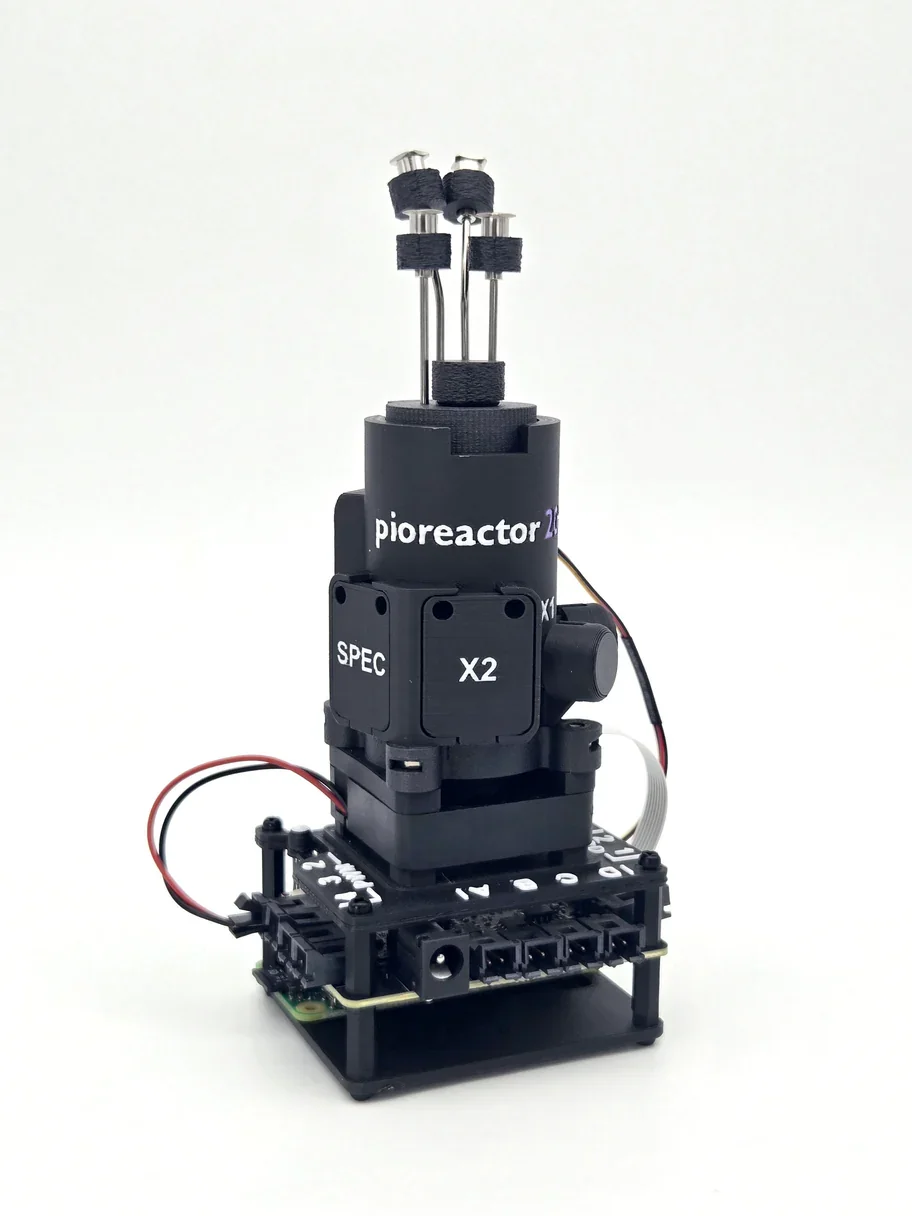
© Pioreactor
In fact, I started university in biology, but quickly became more attracted to my math and computer classes. The interest in biology never fully left, and I dabbled in evolutionary algorithms, evolutionary game theory, and population dynamics. Shortly after graduation, data science became a “thing”, and I worked at tech companies helping to design their data science technologies and teams. After many years of working in tech, I had developed the required leadership and technology skills that would later be required to start my own tech company. However, I was missing biology.
I challenged myself to go back to school to learn more fermentation, optics, and food science. This culminated in building a makeshift wet-lab in my closet where I built my first “bioreactor”: a yeast-filled Erlenmeyer flask on a stirplate. My data science training taught me that we needed data, and fast. This carefully evolved into our core product: the Pioreactor 20ml.
Pioreactor was created to make bioreactor technology more accessible and programmable. What challenges in synthetic biology research or education were you hoping to address when you founded the company?
The core idea of our goal is simple: a lot of problems that look hard are really slow-iteration problems. This is very clear in software development, where you get near instant responses, and if not - you build tools or change designs to make it near instant. Similarly, technologies like CAD, EDA, 3D printing, and LLMs have made getting results faster, which leads to better tools and designs, and hence faster results, and so on. The iteration rate is measured in seconds or minutes (in the worst case). For biologists, they are still working on the scale of hours, days, or even months. This is doubly-costly: you can only try new ideas so fast, and you are responsible for an experiment for longer. We want Pioreactor to do two things: easier horizontal scale out of experiments (more parallel experiments) and faster time-to-result. The former is accomplished by more accessible reactors, and the latter by faster reactor setup and response detection.
Synthetic biology increasingly depends on automation, real-time data collection, and scalable experimentation. How does Pioreactor enable researchers and students to design, monitor, and iterate on biological experiments more effectively?
When I was first tinkering in my makeshift wet-lab, I was really practicing what I call “spray and pray” biology. This is where you set up the experiment, wait however many hours, and then get to make a single measurement - hopefully it’s conclusive - and then wait again.
Pioreactor moves the focus from “spray and pray” practice to a constant feedback model. At each moment, a researcher can see how things are progressing and make adjustments. They can see the effects of their actions, either as biological results or a new signal in the Pioreactor’s interface.
For students interested in careers at the intersection of biology, engineering, and computation, what skills or experiences do you think are most valuable to develop today?
Computers and programming. Computers are still underused, and they are only getting more powerful and more useful for biologists. Programming can be done by AI now - that’s amazing - but biologists still need to know what programming is useful and what is a waste of time. A future biologist might work with hardware via LLMs and programming, and the novel biological ideas they generate will need to be interpreted and implemented by computers.
Looking ahead, what developments in synthetic biology or biomanufacturing are you most excited about, and how do you see tools like Pioreactor helping accelerate innovation in research, education, and entrepreneurship?
I’ll start by saying: I’m not a biologist. I am limited in how feasible some projects are, or how well researched an idea is. That said, I think the microbial and viral worlds have an incredibly powerful search tool we don’t have: evolution. Scientific and medical techniques that take advantage of evolution seem very powerful to me: lab directed evolution, phage therapy, and ecological enzyme discoveries (like PETase) feel like a biological super power.
Pioreactor hopes to play some role in this too: either by being the platform for research into these tools, or inspire the next generation of students to become biotechnologists.
Interviewer: Caitlin Oh
